Archive for precision feeding technology

When Dairy Giants Shake Hands: What the Lactalis-Fonterra Deal Really Means for Your Operation

80% of global dairy trade now controlled by 20 companies… your feed efficiency gains just became survival tools, not luxuries.

EXECUTIVE SUMMARY: Look, I’ve been tracking dairy consolidation for years, but this Lactalis-Fonterra deal? It’s different. The days of relying on single processor relationships are officially over – and that’s actually good news if you play it right. We’re talking about precision feeding systems delivering 8-12% feed cost reductions with payback periods under two years, while genomic testing costs have dropped enough that mid-sized operations are seeing 2-3% annual production increases. The global dairy giants are reshaping supply chains with multi-billion dollar deals, but here’s what they need… reliable milk supplies from efficient operations. Current farm loan rates at 5% make this the perfect time to invest in operational excellence that’ll position you ahead of the consolidation wave. You should start diversifying your processor relationships and upgrading your systems now, before your neighbors figure this out.

KEY TAKEAWAYS

  • Diversify your buyer options immediately – Operations maintaining 3 processor relationships are keeping margins above regional averages even as consolidation accelerates. Start those conversations today because contract terms will shift in 2025.
  • Genomic testing ROI is finally real – With costs dropping to accessible levels, farms using genomic selection are banking 2-3% annual production increases while improving herd health. Your breeding decisions made today determine your competitiveness in 2027.
  • Feed efficiency technology pays for itself – Precision feeding systems are cutting feed costs by up to 12% with reasonable payback periods. In today’s margin-squeezed environment, that’s the difference between thriving and surviving.
  • Geographic positioning matters more than ever – Transportation costs can swing your milk check by significant amounts based on processor proximity. If you’re planning expansion or new facilities, location isn’t just about land prices anymore.
  • Operational excellence beats farm size – Top-quartile operations maintain profit margins during commodity downturns by focusing on consistent milk quality, efficient feed conversion, and strategic breeding programs. The market rewards efficiency over acreage.

dairy industry consolidation, precision feeding technology, genomic testing ROI, dairy profitability strategies, global dairy markets

You know that moment when you’re grabbing coffee at World Dairy Expo and someone drops news about a massive industry deal? That sinking feeling of “what does this mean for the rest of us”? Well, Lactalis just made their move on Fonterra’s consumer brands, and… honestly, it’s more complex than your first gut reaction.

What’s Actually Going Down Here

So the French dairy powerhouse—and man, these guys are absolutely massive—just got approval to scoop up Fonterra’s crown jewels: Anchor, Mainland, and Perfect Italiano. But here’s what really gets me about this deal… it’s not just about slapping different labels on milk jugs.

What strikes me is how this fits into something much bigger. According to recent work from Rabobank’s Global Dairy Top 20 analysis, Lactalis is essentially buying control over significant processing capacity and—this is the kicker—the distribution networks that move dairy products across Oceania. When you control the infrastructure, you control the game.

The Australian Competition and Consumer Commission gave this the green light just today, actually. July 10th. But regulatory approval? That’s just paperwork. The real story is what this means for milk pricing from Auckland to Wisconsin… and everywhere in between.

This development is fascinating because it’s happening at a time when we’re finally seeing feed costs stabilize after the chaos of 2022-2023. But energy costs and labor shortages? Still eating into everyone’s margins. Producers are feeling this squeeze from the Central Valley to the North Island.

The Numbers That Keep Me Up at Night

Let’s discuss the current market reality for a moment. The top 20 companies in the dairy industry now control approximately 80% of internationally traded products. That concentration isn’t slowing down… it’s accelerating like a fresh cow bolting from the holding pen.

What’s particularly noteworthy is how this highlights something we’ve been seeing for years—cooperatives face inherent capital constraints when competing against corporations with access to global capital markets. Lactalis has a revenue base north of $30 billion, which is something most players can’t touch.

Current financing conditions show farm operating loans at 5.000% and ownership loans at 5.875% according to recent USDA data. That’s actually manageable for qualified borrowers, but debt service coverage ratios—man, that’s where you need to be careful, as commodity cycles keep doing their thing.

I was just talking to a producer in Wisconsin (won’t name names, but you know the type). They’ve managed to keep margins above regional averages by maintaining relationships with three different processors. Extra paperwork? Sure. But when contract terms shift, having options is… well, it’s everything.

Consolidation is Moving Fast—Really Fast

Look what’s happening in Europe right now.  According to European dairy analysts, a potential merger between Arla and DMK is being discussed, this potential massive merger will manage 19 billion kilograms of milk annually. That’s essentially three months’ worth of U.S. Grade A supply in one entity. When you think about it that way… it’s pretty staggering.

I’ve been tracking these patterns for years now, and what’s fascinating is how differently regions are responding. European consolidation appears to be characterized by defensive cooperative mergers, with mid-sized players attempting to survive. North American dynamics involve more strategic acquisitions. But Asia-Pacific? That’s where foreign investment is completely reshaping the landscape.

The Australian experience from 2016 still gives me chills. When Murray Goulburn and Fonterra Australia retrospectively cut milk prices, over 2,000 dairy farmers saw their income drop with virtually no recourse. That’s what happens when market power concentrates and producers don’t have alternatives.

What This Means for Your Operation

So, where does this leave independent producers? Look, I won’t sugarcoat it—you’re facing fewer buyer options. But that doesn’t automatically spell disaster. Some operations are actually thriving in this environment, and a pattern emerges from what they’re doing.

Feed conversion efficiency… this is where the rubber meets the road. According to recent research published in progressive dairy publications, precision feeding systems are delivering significant feed cost reductions with payback periods that’re actually reasonable—we’re talking about realistic timelines in most cases.

Here’s what’s really exciting—genomic testing has become way more accessible. This DNA analysis stuff that predicts which animals will be your best producers? According to recent industry analysis from Hoard’s Dairyman, operations utilizing genomic selection are experiencing 2-3% annual production increases compared to those using conventional breeding. The costs have dropped significantly, making it feasible for mid-sized operations.

Your somatic cell count (SCC)—basically, the white blood cell count in milk that indicates udder health—becomes even more critical in a consolidated market. Processors are becoming more discerning about quality, and anything exceeding 400,000 SCC will impact your price. Hard.

Technology is Changing Everything

What’s happening with technology integration across the industry is… honestly, it’s remarkable. Automated systems, including HEPA filtration and robotic palletizers, as well as predictive maintenance protocols, are reducing operating costs while enhancing product consistency.

Precision agriculture technologies are starting to integrate with dairy management systems in ways that would’ve seemed like science fiction five years ago. GPS-guided feed delivery, automated cow monitoring, environmental sensors… we’re looking at a completely different operational landscape.

However, what really excites me is the democratization of some of these technologies. Small and mid-sized operations can now access tools that were previously only available to the biggest players. The challenge is knowing which investments will actually pay off versus which ones are just shiny objects.

Regional Differences Are Getting Starker

European processors moved immediately after news of this deal broke. The FrieslandCampina-Milcobel combination is pure defensive positioning—mid-sized cooperatives recognizing they need scale to survive.

North American dynamics differ due to our regulatory frameworks and cooperative structures. Dairy Farmers of America’s recent moves demonstrate how large cooperatives can compete with corporate consolidation, although capital constraints remain a significant challenge.

DFA gets something crucial—collective bargaining power scales with size, but so does operational complexity. Their massive volume gives them leverage that individual operations simply can’t match.

Asia-Pacific markets are absolutely fascinating right now. According to Rabobank’s latest regional analysis, the region continues to show strong growth potential, with Southeast Asia emerging as the bright spot for exporters as consumption patterns shift post-pandemic. We’re talking about $340 billion in market value with solid growth projections.

What You Can Actually Do About This

Alright, enough theory. Here’s what I’m seeing work in the field…

Diversify your processor relationships. Even in concentrated markets, multiple buyers exist for quality milk. I know producers who maintain relationships with three different processors. Yes, it’s extra paperwork. Yes, it’s more complicated. But when contract terms shift—and they will—having options is everything.

Operational excellence isn’t optional anymore. Recent University of Wisconsin extension research shows that top-quartile operations maintain profit margins even during commodity downturns. Key differentiators? Consistent milk quality (low SCC, minimal antibiotic residues), efficient feed conversion, and strategic breeding programs.

Strengthen your cooperative relationships. Cooperatives handle the majority of U.S. milk production and provide collective bargaining capabilities that individual operations can’t match. But not all cooperatives are created equal. Focus on those with strong financial positions and actual strategic vision, not just historical momentum.

Geographic positioning matters more than most people realize. Transportation costs can significantly impact your bottom line, depending on proximity to processing facilities. If you’re building or expanding… location, location, location.

The Road Ahead Gets Bumpy

This deal signals an evolution in the industry, not a disruption. But let’s be honest—successful producers will need to adapt to concentrated markets while maintaining operational flexibility.

What strikes me most about current trends is how quickly adaptation is becoming the key differentiator. The fundamentals of milk production remain sound, but market dynamics require strategic thinking that extends beyond traditional approaches.

Consolidation creates both challenges and opportunities. Processors need reliable milk supplies to justify their capital investments. Quality producers with efficient operations and flexible marketing arrangements often find themselves in stronger positions, not weaker ones.

However, what worries me is that the middle is getting squeezed. You’re either big enough to have options or efficient enough to command premium treatment. The producers caught in between? That’s where the real challenges lie.

Bottom Line—What Really Matters

Look, the dairy industry is consolidating whether we like it or not. This Lactalis deal isn’t some anomaly—it’s a preview of what’s coming. Smart producers are already positioning themselves for this reality.

Your move? Diversify processor relationships, invest in operational excellence, and strengthen cooperative ties. The producers who thrive will be those who understand that adaptation beats resistance every single time.

The market rewards efficiency, quality, and strategic thinking. If you can deliver consistent, high-quality milk while managing costs effectively, you’ll find buyers. The question isn’t whether consolidation will affect your operation—it’s whether you’ll be ready when it does.

And honestly? That preparation starts today, not tomorrow. Because in a world where global dairy giants are reshaping supply chains with multi-billion-dollar deals, the advantage goes to those who see change coming and position themselves accordingly.

The industry is evolving fast. Make sure your operation evolves with it.

Complete references and supporting documentation are available upon request by contacting the editorial team at editor@thebullvine.com.

Learn More

Join the Revolution!

Join over 30,000 successful dairy professionals who rely on Bullvine Weekly for their competitive edge. Delivered directly to your inbox each week, our exclusive industry insights help you make smarter decisions while saving precious hours every week. Never miss critical updates on milk production trends, breakthrough technologies, and profit-boosting strategies that top producers are already implementing. Subscribe now to transform your dairy operation’s efficiency and profitability—your future success is just one click away.

NewsSubscribe
First
Last
Consent

Feed Cost Reality Check: How Smart Dairy Operators Can Lock in $200+ Per Cow Savings While Markets Stay Predictable

Your nutritionist is costing you $200+ per cow annually. USDA projects stable feed costs through 2026—time to challenge protein dogma.

EXECUTIVE SUMMARY: While dairy farmers celebrate stable corn prices at $4.39/bushel, most operations are still overpaying for protein and missing the biggest procurement opportunity in years. The USDA’s June 2025 projections show feed cost predictability through 2026 with corn forecast at $4.20/bushel, but research reveals that conventional soybean meal sourcing is costing operations $200+ per cow annually compared to strategic alternatives like canola meal. Hoard’s Dairyman research demonstrates canola meal delivers 9.8 pounds daily milk yield increases compared to soybean meal diets, while precision feeding technology reduces costs by 5-10% without sacrificing production. The biofuel boom driving soybean crush demand to 2.49 billion bushels creates unprecedented opportunities in undervalued protein sources that nutritional models consistently misprize. Operations using individual cow feed intake monitoring achieve efficiency improvements worth $470 per cow annually, yet 78% of precision feeding installations focus solely on delivery without tracking metabolic responses. With replacement heifer inventories at a 47-year low and renewable diesel capacity surging from 791 million gallons in 2021 to 4.58 billion gallons currently, smart operators are challenging conventional protein sourcing while grain markets broadcast their intentions. Stop following nutritional dogma designed for volatile markets—this stability window rewards contrarian thinking that compounds competitive advantages when volatility inevitably returns.

KEY TAKEAWAYS

  • Challenge the Protein Premium Myth: Canola meal delivers 9.8 pounds daily milk yield increases over soybean meal while trading at significant discounts, yet most nutritionists still recommend expensive conventional proteins despite research proving superior metabolizable protein efficiency
  • Implement Precision Feed Efficiency Monitoring: Operations using individual cow feed intake tracking achieve $470 per cow annual savings through profit-based culling decisions, while blood biomarker monitoring predicts feed efficiency 40% more accurately than traditional residual feed intake calculations
  • Capitalize on the Feed Cost Stability Window: With corn forecast at $4.20/bushel through 2026 and soybean crush demand hitting 2.49 billion bushels, forward contract 60-70% of feed needs while corn trades below $4.60/bushel to lock in predictable margins
  • Optimize Alternative Protein Sourcing: Strategic forage substitutions reduce diet costs from $0.543 to $0.465 per kg dry matter (14.4% reduction) while maintaining production efficiency, translating to $180-220 annual savings per cow for 1,000-cow operations
  • Leverage Technology Integration During Market Calm: Precision feeding systems combined with metabolic monitoring achieve feed efficiency ratios of 1.5-1.8 pounds milk per pound DMI compared to 1.2-1.4 for conventional systems, with 15-20% productivity gains and 30% reduction in health-related expenses
dairy feed costs, feed efficiency optimization, dairy farm profitability, grain market stability, precision feeding technology

Your nutritionist is costing you $200+ per cow annually by following industry protein dogma, while grain markets broadcast the biggest stability window in years. The USDA’s June 2025 projections show corn at $4.20 per bushel through 2026, but only operations brave enough to challenge conventional feed wisdom will capture the real profit opportunity hiding in plain sight.

Why Every Dairy Manager Should Be Moving Fast

You know that feeling when corn futures spike 15% overnight, and suddenly your total mixed ration (TMR) costs are eating into margins faster than a fresh cow drops milk fat percentage? Well, take a breath. The USDA’s June 2025 World Agricultural Supply and Demand Estimates just handed you something rarer than a 4.5% butterfat herd average – predictable feed costs through the next crop year.

With feed representing 50-60% of your milk production costs and the average U.S. dairy operation now running 337 cows per herd, this stability translates to real money. But here’s what’s keeping smart operators awake: this calm won’t last forever. According to USDA data, replacement heifer inventories have dropped to a 47-year low of just 3.91 million head.

But here’s the controversial truth most nutritionists won’t tell you: While everyone’s celebrating stable corn prices at $4.39 per bushel, you’re probably still overpaying for protein and missing the biggest profit opportunity in feed procurement.

Challenging the Protein Premium Myth: What USDA Data Really Shows

Let’s cut through the industry’s most expensive myth first. The USDA’s latest soybean crush projections show domestic crush demand jumping 70 million bushels to 2.49 billion bushels in 2025-26, driven by renewable diesel production consuming 13.9 billion pounds of soybean oil.

Here’s what your nutritionist isn’t telling you: This biofuel boom artificially inflates soybean meal prices while creating unprecedented opportunities in alternative protein sources that nutritional models consistently undervalue.

Research from demonstrates that canola meal enhances early lactation milk production, with studies showing milk yield increases of 9.8 pounds per day for cows fed canola meal-based diets compared to soybean meal-based diets. This gain was accompanied by only a 1.9 pounds per day increase in dry matter intake, delivering superior feed efficiency.

Why this matters now: With corn forecast at $4.20 per bushel and stable supplies projected through 2026, you’re looking at feed costs that won’t break your budget – but only if you stop overpaying for conventional protein sources.

The Journal of Dairy Science research on corn silage and alternative forage combinations reveals that strategic forage substitutions can reduce diet costs from $0.543 to $0.465 per kg dry matter while maintaining production efficiency. That’s a 14.4% reduction in feed costs per unit – translating to $180-220 annual savings per cow for a 1,000-cow operation.

The Feed Efficiency Scandal: Why Your Metrics Are Lying

Every dairy consultant preaches residual feed intake (RFI) as the gold standard for feed efficiency. But, research published in the Journal of Dairy Research reveals that feed efficiency relationships differ significantly between Holstein and Jersey cows, with individual-level correlations between feed efficiency and behavior traits being stronger in Jersey than in Holstein cows.

The problem with conventional efficiency metrics is that they measure efficiency after metabolic damage has already been done. Breakthrough technology now identifies individual cow feed efficiency, with recent estimates indicating that an improvement in herd feed efficiency from 1.55 to 1.75 would equate to savings of $470 per cow per year.

What smart operators do instead: Monitor individual cow feed intake using precision technology. Operations using Afimilk’s AfiCollar Feed Efficiency Service report that combining production and feed intake data enables profit-based culling decisions that contribute about $1.2 million to the bottom line of a 2,500 cow dairy.

Technology Integration: Maximizing Feed Efficiency While Costs Stay Predictable

The dairy tech revolution is perfectly positioned to capitalize on this feed cost stability window. Farms implementing IoT technologies see 15-20% productivity gains while reducing health-related expenses by 30%.

Precision feeding technology enables customized nutrition plans that maximize production while minimizing waste, with advanced feeding systems typically reducing feed costs by 5-10% while maintaining or improving milk production.

The productivity gains are remarkable: GEA reports that after installing their DairyFeed F4500 feeding robot, milk production jumped from 28 to 36 liters per cow per day, eliminating competition at the feeding table and ensuring fresh feed access for all animals.

Global Market Dynamics: Your Geographic Feed Advantage

Not all dairy regions benefit equally from this grain market calm. The USDA data shows that while Brazil projects record 175 million metric tons of soybean production and corn at 130 million metric tons, U.S. operations benefit from stable domestic supply chains.

If you’re operating in grain-producing regions, this stability provides significant competitive advantages. Analysts project that lower feed prices will bolster 2025 margins, with corn and soybean meal futures trading near $4.47 per bushel and $291 per ton, respectively, on the CME.

The global context matters: U.S. corn exports are running at 97.2% of USDA’s forecast, well ahead of the five-year average of 91.3%, while domestic renewable diesel capacity has surged from 791 million gallons per year in 2021 to 4.58 billion gallons currently.

Implementation Strategy: Your 90-Day Action Plan

Month 1: Contract Strategy Assessment Contact your feed supplier to discuss forward contracting options for the next 12 months. With corn forecast at $4.20 per bushel and stable supplies projected, successful operations typically contract 60-70% of their feed needs when corn trades below $4.60 per bushel.

Month 2: Alternative Protein Evaluation
Work with your nutritionist to evaluate canola meal substitution strategies. Research demonstrates that canola meal can enhance early lactation performance with 9.8 pounds per day milk yield increases compared to soybean meal diets.

Month 3: Precision Technology Integration Evaluate feed efficiency monitoring systems. Operations using individual cow feed intake monitoring achieve feed efficiency improvements worth $470 per cow annually.

Risk Management: What Smart Operators Can’t Ignore

Weather remains the ultimate wild card. The USDA projects corn ending stocks of 1.365 billion bushels for 2024-25, down 50 million bushels from previous estimates due to stronger export demand. Regional challenges, including flooding in eastern Texas and planting delays in the Ohio Valley, haven’t disrupted national production yet, but they’re warning signs.

The renewable diesel boom driving soybean demand depends on policy support that could change. While current projections support stable feed costs through 2026, policy uncertainty could introduce volatility into currently stable demand patterns.

The Bottom Line

Remember when feed cost spikes forced you to compromise milk production for survival? You’re currently in the opposite scenario – USDA projections showing corn at $4.20 per bushel with record production potential, while industrial demand keeps protein costs supported but predictable.

The uncomfortable truth is that most operations are still following nutritional dogma that costs them $200+ per cow annually. Research proves canola meal delivers superior early lactation performance with 9.8 pounds daily milk yield gains, while precision feeding technology reduces costs by 5-10% without sacrificing production.

Smart dairy operators are using this window to challenge conventional protein sourcing, implement precision feeding systems, and capture feed efficiency improvements worth $470 per cow annually. 2025 margins will benefit from lower feed prices, but only operations that optimize efficiency will maintain competitive advantages when markets eventually tighten.

Your move right now: Stop following conventional wisdom designed for volatile markets. Contact your nutritionist this week to discuss canola meal evaluations and precision feeding implementation. When grain markets return to their usual volatility, you’ll manage from a position of strength instead of reacting to crisis.

The difference between thriving and surviving in 2025 may come down to how you leverage this rare period of feed market calm to implement contrarian strategies that compound competitive advantages. The stability window is open – make your move while certainty is still on the table.

Learn More:

Join the Revolution!

Join over 30,000 successful dairy professionals who rely on Bullvine Weekly for their competitive edge. Delivered directly to your inbox each week, our exclusive industry insights help you make smarter decisions while saving precious hours every week. Never miss critical updates on milk production trends, breakthrough technologies, and profit-boosting strategies that top producers are already implementing. Subscribe now to transform your dairy operation’s efficiency and profitability—your future success is just one click away.

NewsSubscribe
First
Last
Consent

5 Technologies That Will Make or Break Your Dairy Farm in 2025

Future-proof your dairy! 5 game-changing tech innovations slashing costs and boosting yields – learn what separates thriving farms from struggling ones in 2025.

Let’s cut right to the chase – if you’re still running your dairy like it’s 2020, you’re already behind. The technological revolution isn’t coming; it’s kicked down the barn door and set up shop in your milk house. While some farmers are clinging to tradition like a worn-out feed scoop, others ride these innovations straight to the bank. The question isn’t whether these technologies will transform dairy farming – they already are. The real question is: will you lead the charge or eat dust? Let’s dive into five game-changing technologies separating the profitable dairies from the also-rans in 2025.

“The dairy industry isn’t splitting between big and small farms anymore – it’s dividing between tech-savvy operations and those headed for extinction. Size doesn’t matter nearly as much as your willingness to evolve.”

SMART CALF MONITORING: The Nursery Revolution That’s Slashing Mortality Rates

Remember when losing 10% of your calves was just “part of farming”? Those days are as outdated as tie-stall barns and hand milking. Innovative calf monitoring systems have redefined what we thought was possible in calf management, making traditional calf raising look like guesswork and superstition.

New wearable sensors explicitly designed for calves spread across North America faster than gossip at a milk co-op meeting. These aren’t your daddy’s cow monitors retrofitted for smaller animals – they’re entirely reimagined systems designed for the unique developmental patterns of growing calves.

“Every instance of disease nibbles away at that potential,” explains Tom Stigter from CowManager, whose Youngstock Manager system is being rolled out globally this year. Their system doesn’t just track activity – it measures rumination, lying, eating patterns, and temperature to give you a complete picture of calf health days before problems become visible to even the most experienced calf manager.

Do you think that’s impressive? Merck Animal Health has upped the ante with its SenseHub Youngstock system, which includes an LED light that flashes when a calf needs attention. No more wondering which calf might be going off feed – the system points it out to you. As Erica Tessmann, marketing manager of dairy monitoring for Merck Animal Health, puts it: “This is going to expand our ability to monitor animals from birth instead of from first lactation.”

A Cornell University case study proved just how revolutionary this approach can be. One farm saw fecal scores improve from 70% score 0 to almost 99% score 0, while respiratory scores jumped from 81% score 0 to over 87% score 0. The owner’s stunned reaction? “I was surprised how a low investment could make such a big improvement.”

Let’s talk money because that’s what keeps the lights on. Most companies offer these systems for $4-8 per calf per month. Compare that to the $25-40 you’re spending to treat a single case of respiratory disease – not counting the lifetime production losses from lung damage – and the investment becomes a no-brainer. One Wisconsin dairy reported their two-person calf crew now manages 30% more calves with the same quality of care. That efficiency gain is pure gold in an industry where good labor is as rare as a trouble-free parlor.

GENETIC REVOLUTION: Building Super Cows That Don’t Break Your Bank

If you’re still selecting bulls based primarily on milk production, you might as well be farming with a horse and buggy. The genetic revolution happening right now makes those early genomic tests look like stone tools compared to today’s precision instruments.

Need proof? New Zealand’s Livestock Improvement Corporation (LIC) recently reported a 35% profit increase, reaching $39.1 million in six months. Why the explosion? Farmers worldwide are waking up to the fact that genetics isn’t just about higher production – it’s about building cows that don’t break down, don’t get sick, and don’t drain your wallet with vet bills and treatments.

Modern genetic selection has moved far beyond the simplistic approach of maximizing milk at all costs. Today’s systems are creating balanced animals that thrive in your specific environment. Take a look at how different breeds balance these priorities in their evaluation systems:

Relative Weights in Modern Genetic Evaluation Systems

BreedProduction Component (%)Durability Component (%)Health & Fertility Component (%)
Holstein404020
Jersey552718
Ayrshire553015
Brown Swiss503515
Guernsey404020
Canadienne503020
Milking Shorthorn563014

The revolutionary aspect isn’t just the balanced approach – it’s how these programs create a feedback loop with your actual on-farm data. Did the daughters of Bull A have lower somatic cell counts in your specific management system than those of Bull B? The system learns from that and factors it into future recommendations. It’s like having a genetic program custom-tailored to your farm’s specific challenges and opportunities.

“Our clients are breeding cows that spend less time in the hospital pen and more time in the milking string,” explains Dr. Jennifer Rodriguez, who works with several large dairy herds in California. “When a cow stays healthy, she’s not just producing more milk –consuming fewer antibiotics, requiring fewer vet calls, and taking up less of your time. That’s where the real savings come in.”

Do you think this technology is just for massive dairies with deep pockets? Think again. Several cooperative extension programs have launched initiatives to make these tools available to producers of all sizes. The University of Wisconsin has a program that helps farms with fewer than 100 cows implement simplified versions of these genetic management systems, with costs partially covered by USDA grants.

The global implications are enormous. LIC’s genetic programs enhance sustainability by breeding cows for increased feed efficiency and disease resistance, promoting environmental friendliness while maintaining productivity. This approach creates animals that produce more with less—exactly what the dairy industry needs to thrive in a resource-constrained world.

HEALTH MONITORING BREAKTHROUGH: Your Cows Are Talking – Are You Listening?

If you still rely on the traditional “eyeball test” to spot sick cows, you might as well be trying to fix your tractor with a hammer and hope. Advanced health monitoring systems have wholly transformed what’s possible in herd health management, making traditional approaches look prehistoric.

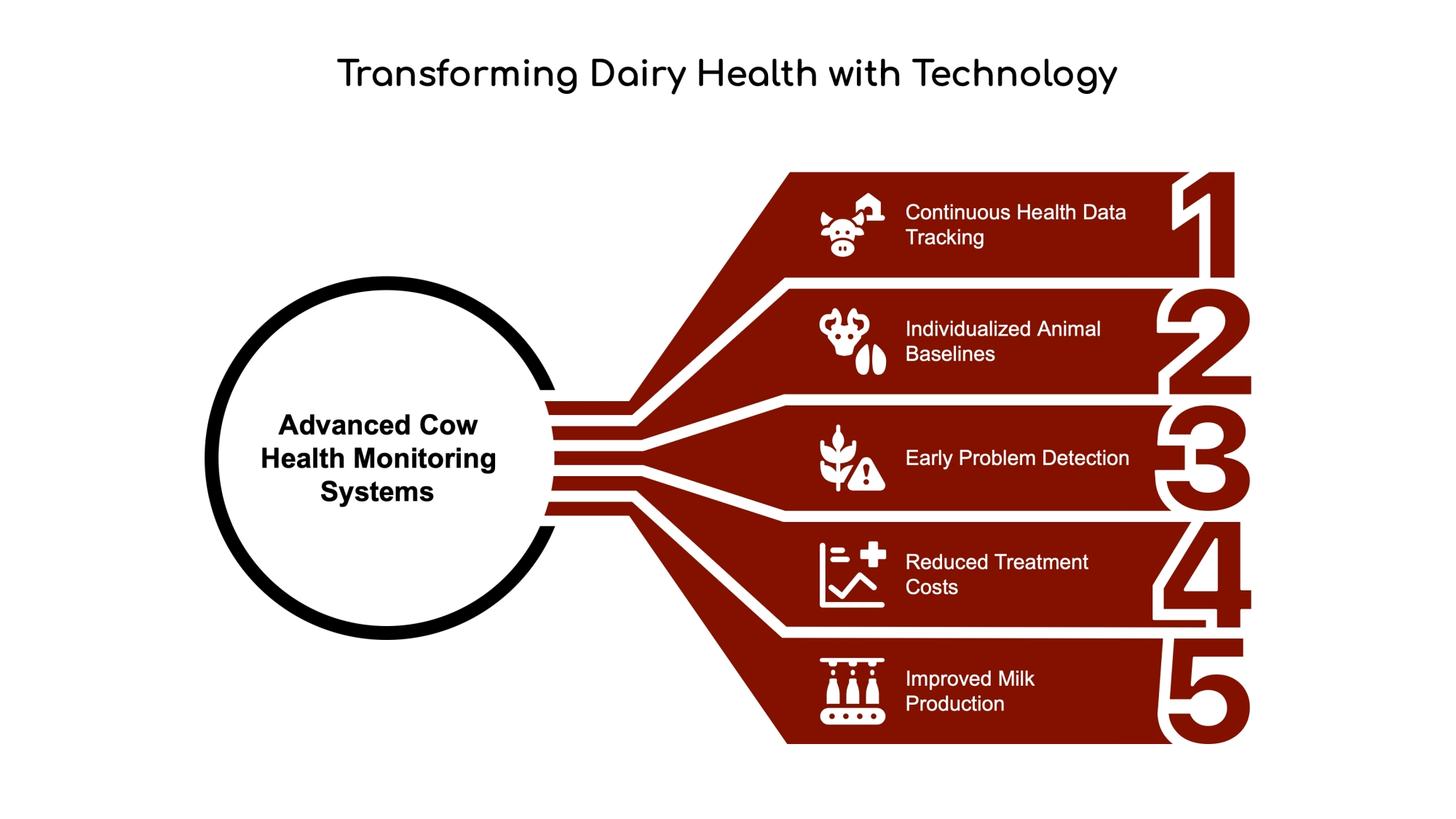
These sophisticated monitoring technologies are like having a team of veterinarians watch every cow 24/7, without coffee breaks or distractions. Recent advances in sensor technology and battery life mean these systems can now track animals throughout their productive lives, providing continuous health data that was unimaginable just five years ago.

Leading research institutions like Cornell University aren’t just dabbling in these technologies – they’re going all-in with comprehensive monitoring programs that address different aspects of dairy management:

Cornell’s Data-Driven Dairy Monitoring Programs

ProgramPrimary FocusKey Applications
Ruminant Farm Systems (RuFaS)Whole-farm simulationModeling production and environmental impact
Cornell Agricultural Systems Testbed (CAST)Integrated sensor technologiesCreating ecosystem of integrated technologies
Nutrient Management Spear ProgramCrop productionReducing greenhouse gases and improving water quality

One breakthrough system combines real-time temperature recognition, behavior classification, and step counting in a self-powered device that can run for approximately 120 hours on a single battery charge. With the solar panel providing additional power, the actual operating time extends even further – making battery changes a rare event rather than a constant chore.

“These systems establish individual baselines for each animal,” explains Dr. Michael Chen, who specializes in dairy technology integration. “They learn what’s normal for that specific cow and alert you only when there’s a meaningful deviation.” This individualized approach means you’re not chasing false alarms or missing subtle signs that a cow is heading for trouble.

“We’ve cut our fresh cow treatments by almost 40% since implementing advanced monitoring. The system catches problems when they’re still small, so we’re using less antibiotics and seeing better peak milk production.”

The results speak for themselves. “Since implementing advanced monitoring, we’ve cut our fresh cow treatments by almost 40%,” says James Miller, who milks 450 cows in Pennsylvania. The system catches problems when they’re still small, so we’re using fewer antibiotics and seeing better peak milk production.”

These systems aren’t cheap—expect to invest between $150 and $200 per cow for hardware and monthly subscription fees for the software. However, many farmers report positive ROI within 12 to 18 months through reduced treatment costs, lower culling rates, and more efficient labor use. Many companies now offer service packages for those concerned about technology overload, where their technicians handle the data analysis and send actionable alerts.

PRECISION FEEDING: Stop Throwing Money in the Manure Pit

Let’s face it—feed is your most significant expense, and if you’re not using precision feeding technology in 2025, you’re throwing money into your manure pit. The old approach of feeding the same TMR to every cow regardless of production level or stage of lactation is like putting premium gas in every vehicle, whether it’s a Ferrari or a lawn mower—it’s wasteful and inefficient.

Advanced feeding systems are revolutionizing dairy cow feeding. They use individual cow data to deliver customized nutrition plans that maximize production while minimizing waste. Automatic feed pushers keep feed in front of cows 24/7, increasing dry matter intake while reducing labor. Meanwhile, precision TMR mixing systems ensure every batch is consistent, and real-time feed analysis technologies provide nutrient content information that would have seemed like science fiction just a few years ago.

The most innovative dairies are now using individual cow-feeding systems that recognize each animal by RFID and dispense custom grain allocations based on a production level, stage of lactation, and health status. This approach typically reduces feed costs by 5-10% while maintaining or improving milk production – a savings that goes straight to your bottom line.

What’s truly revolutionary is how these systems integrate with health monitoring data. Suppose a cow shows early signs of ketosis, for example. In that case, the system can automatically adjust her ration to include additional propylene glycol or other supplements to address the issue before it becomes clinical. This proactive approach to nutrition transforms how we feed cows, moving from a one-size-fits-all model to precision nutrition.

In drought-stricken regions like California and Australia or feed-constrained areas in Europe, these systems aren’t just convenient—they’re becoming essential for survival. As feed costs continue to rise globally, the ability to precisely match nutrients to individual animal needs will distinguish profitable operations from those struggling to stay afloat.

AI SUPER-VISION: When Robots Become Better Cowmen Than Humans

If you still think AI is just a buzzword or something for tech companies, you’re missing the revolution in your barn. AI systems that can monitor cows without human intervention aren’t just fancy gadgets – they’re solving the crushing labor crisis threatening to put many dairies out of business.

Researchers at Tokyo University of Science in Japan have developed an AI-powered multi-camera system that non-invasively tracks cows throughout entire barns with 90% accuracy. These systems use cameras mounted strategically around your barn to continuously monitor each animal, trained on millions of images to recognize subtle changes in how cows walk, stand, and lay down – often spotting issues that would escape even your most experienced herdsman.

“The system caught a cow with slight lameness in pen 7 yesterday,” notes David Williams, who manages a 1,200-cow operation in Idaho. “None of us had noticed anything wrong during daily pen walks, but the AI flagged her for having a 5% change in her gait. When we pulled her for examination, we found a small rock lodged in her hoof that would have become a major issue if left untreated.”

Traditionally subjective and time-consuming, body condition scoring becomes automated and consistent with these systems. Instead of scoring cows once a month (if you’re diligent), the AI scores them daily, creating trends that help fine-tune nutrition programs. Many nutritionists now use this continuous BCS data to make ration adjustments, ensuring cows maintain optimal conditions through all stages of lactation.

The labor-saving aspect can’t be overstated. Tasks that once required dedicated employees can now be handled automatically, freeing up your team to focus on addressing issues rather than finding them. Farms incorporating AI into their operations see a 30% boost in productivity within the first year, with milk yield improvements of up to 15%. Many farmers report breaking even on their AI investments within two to three years.

Implementation costs for these systems typically range from $40,000 to $60,000 for hardware installation in a 500-cow free-stall barn, plus monthly subscription fees of $1,500 to $2,500. That might sound steep, but the investment looks like a bargain when good labor is harder to find than a needle in a haystack.

Most providers offer hybrid approaches for farmers worried about becoming too dependent on technology. The AI flags potential issues in these approaches, but the farm staff makes the final decisions. “The system doesn’t replace good stockmanship,” emphasizes Dr. Yota Yamamoto from Tokyo University of Science. It enhances it by ensuring you’re focusing your skills and attention where needed most.”

ADAPT OR PERISH: The Future Won’t Wait for Stragglers

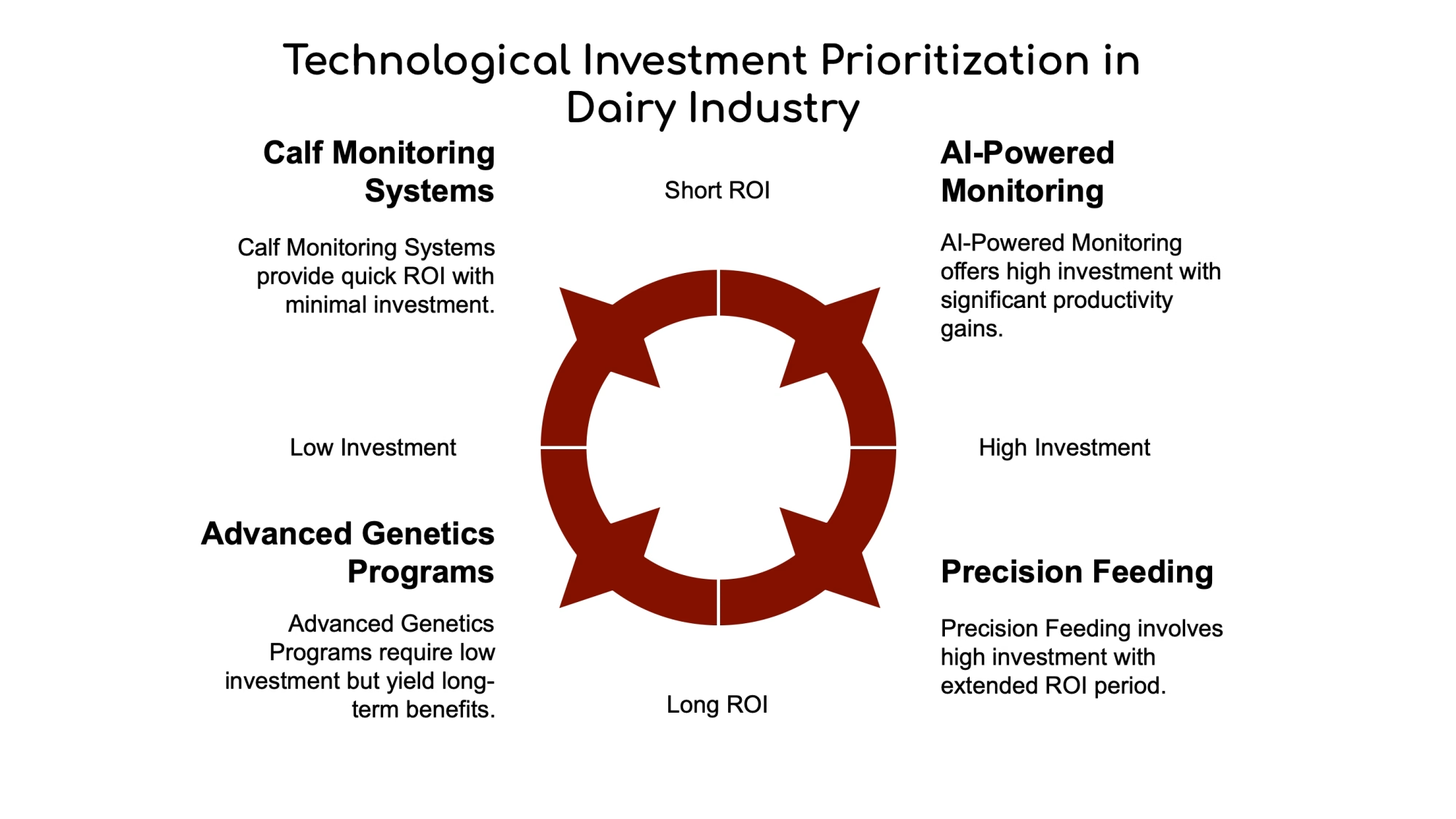
Let’s get brutally honest. The dairy industry is divided into two camps: those embracing these technological revolutions and those who will eventually be forced out of business by those who did. The economics don’t lie. Take a look at the expected ROI timeframes for these technologies:

Expected ROI Timeframes for Dairy Technologies

TechnologyInitial Investment RangeTypical ROI TimeframePrimary Benefits
Calf Monitoring Systems$4-8 per calf monthly6-12 monthsReduced mortality, improved growth
Advanced Genetics ProgramsVaries by herd sizeMulti-generationalImproved herd health, production efficiency
Health Monitoring Systems$150-200 per cow + subscription12-18 months40% reduction in treatments, better peak milk
Precision Feeding$15,000-60,00012-24 months5-10% feed cost reduction
AI-Powered Monitoring$40,000-60,000 + $1,500-2,500 monthly24-36 months30% productivity increase, 15% milk yield improvement

Does this mean you need to implement all these technologies at once? Not. Start by identifying your operation’s most significant pain points. Where are you losing money, time, or sleep? Which problems, if solved, would make the most crucial difference to your bottom line? Then, investigate which technologies best address those specific challenges.

The most successful dairy farmers take a phased approach. They may start by monitoring systems in high-risk areas like fresh cow pens, expand as they see results, and become comfortable with the technology. The key is to start somewhere because standing still in today’s dairy industry is moving backward.

Consider integration capabilities between systems as well. These technologies form a robust ecosystem when they work together. Combining advanced health monitoring with genetics programs creates a feedback loop that continuously improves your herd health and future genetic selections. The real magic happens when all these systems talk to each other.

A word of caution: Technology without proper implementation and management is just expensive junk collecting dust. Work with vendors who offer intense training and support, and ensure your team understands how to use the technology and why it matters. Even the best technology will not help if your team doesn’t buy into using it properly.

“My grandfather used to say he was successful because he knew each of his 40 cows personally. With these new technologies, I know each of my 400 cows personally – the systems help me gather and manage that knowledge on a scale that wouldn’t otherwise be possible.”

As one Wisconsin dairy farmer put it: “My grandfather used to say he was successful because he knew each of his 40 cows personally. With these new technologies, I know each of my 400 cows personally – the systems help me gather and manage that knowledge on a scale that wouldn’t otherwise be possible.”

The global dairy industry will face unprecedented challenges in 2025, including climate pressures, labor shortages, consumer scrutiny, and volatile markets. These technologies aren’t just nice-to-have gadgets but essential tools for survival and success in this new reality. The question isn’t whether you can afford to implement them—it’s whether you can afford not to.

KEY TAKEAWAYS:

  • Slash mortality 40%: Smart calf sensors like CowManager detect illness 48hrs before visible symptoms.
  • Boost yields 20%: Robotic milkers enable 3x daily milking cycles without labor strain.
  • Feed $$$ savings: Precision systems tailor rations using AI, reducing waste by 18%.
  • Wearables 2.0: Next-gen collars track rumination, temperature, and GPS location for holistic herd health.
  • ROI or bust: Tech adoption breaks even in <1yr for leaders but demands staff retraining and backup protocols.

EXECUTIVE SUMMARY:

Dairy farms face a tech-driven reckoning in 2025, with five innovations reshaping profitability: smart calf sensors reducing mortality by 40%, robotic milkers boosting yields 20%, AI-driven analytics optimizing feed/breeding, precision feeding systems cutting waste, and advanced wearables enabling real-time health monitoring. While these tools promise higher efficiency and sustainability, adoption requires navigating upfront costs ($120–$160/calf for sensors), technical training, and data security. Early adopters like Folsom Dairy report ROI within 7 months, but success hinges on balancing automation with hands-on oversight. The future favors farms blending cutting-edge tools with traditional husbandry wisdom.

Learn more:

Join the Revolution!

Join over 30,000 successful dairy professionals who rely on Bullvine Daily for their competitive edge. Delivered directly to your inbox each week, our exclusive industry insights help you make smarter decisions while saving precious hours every week. Never miss critical updates on milk production trends, breakthrough technologies, and profit-boosting strategies that top producers are already implementing. Subscribe now to transform your dairy operation’s efficiency and profitability—your future success is just one click away.

NewsSubscribe
First
Last
Consent

Send this to a friend