


Archive for farm consolidation trends

The Italian Warning: Why Your Cooling Fans Won’t Save You in 2030

$100K cooling system? Italian dairy families invested $50K in cheese vats instead—and DOUBLED profits.

EXECUTIVE SUMMARY: North American dairy faces an Italian preview: fourth-generation cheesemakers abandoning volume for value as cooling systems prove only 40% effective against extreme heat, exposing our industry’s dangerous bet on technology over adaptation. Wisconsin’s brutal arithmetic—7,000 farms vanished while production rose 5%—reveals that mid-sized operations carrying debt below the $18/cwt profitability threshold are mathematically doomed by 2030. Producers face three proven escape routes: scale to 2,000+ cows with $500K investment, pivot to seasonal/specialty for premium markets despite 30% volume cuts, or capture 10X commodity prices through on-farm processing. The clock is unforgiving—Q1 2026 marks the last moment to choose your path and begin the 3-4 year transition before market forces choose for you. Water scarcity, dependence on immigrant labor, and soil depletion compound the timeline, while genetic decisions force an uncomfortable trade-off: bulls whose daughters survive the August heat produce 500kg less milk annually. Italian farmers who accepted this reality doubled their profits; those who fought it with technology are gone. Your cooling fans won’t save you in 2030—but choosing the right business model today might.

Dairy Heat Stress Management

You know, I’ve been following what’s happening with dairy farmers in southern Italy, and it’s got me thinking about our own future here. These multi-generation families—some going back to their great-grandfathers—they’re not just adding bigger fans when the heat and drought hit. They’re completely rethinking how they farm.

Here’s what’s interesting: instead of fighting the climate with more technology, many are shifting to seasonal production with those beautiful heritage breeds like Podolica cattle. Moving from fresh mozzarella to aged cheeses that hold up better in both heat and volatile markets. Less milk, sure, but products that work with the reality they’re facing.

The European agricultural monitoring agencies have been tracking this, and the numbers tell a story. Summer milk production in Italy’s heat-affected regions has been declining by double digits over the past few years, and there’s been a steady increase in farms closing or transitioning. It’s not a crisis as much as it’s a transformation—and as I talk with producers from Vermont to California, I’m hearing remarkably similar questions bubbling up.

The insights I’m sharing here draw from extension research, industry data, and patterns I’ve observed across numerous dairy operations over recent years.

The Timeline We’re All Watching

Let me share what the research is telling us about the next decade, because this window for making strategic choices—it’s narrower than most of us realize.

The land-grant universities have been remarkably consistent. Cornell, Wisconsin, Minnesota—they’re all pointing to about a five-year period where we can still be proactive. After that? Well, the market and Mother Nature start making more of the decisions for us.

According to the U.S. Global Change Research Program’s latest work, by 2030, we’re looking at average temperature increases of 1.5 to 2.5 degrees Fahrenheit across dairy country. Now that might not sound like much sitting here, but translate that to your barn in July. We’re talking measurable production losses—maybe just over one percent nationally to start, but it won’t hit everyone equally. Some regions will feel it harder.

By 2040—and this is what really gets my attention—the modeling from multiple universities suggests heat stress days could double or even triple from what we see now. Instead of managing through 10 or 15 tough days, imagine 30 or 40 where even your best management can’t fully compensate.

Producers I’ve talked with in Wisconsin are already seeing this shift. What used to be a handful of brutal days has turned into weeks where the cows just can’t catch a break. And those power bills? Several operations tell me their cooling costs last summer ate up everything they’d saved for improvements.

Here’s the sobering part: research from both U.S. institutions and international teams, including work from Israel’s Institute of Animal Science, published in recent years, shows that even effective cooling technology mitigates only about 40% of production losses during extreme heat events. That’s not the technology failing—that’s just the reality of what we’re up against.

That Six-Figure Cooling System Question

So let’s talk about what everyone’s pushing—these comprehensive cooling systems. I’ve been looking at the real numbers from extension programs, and honestly, the range is eye-opening.

For smaller operations, say 50 to 100 cows, Penn State Extension and others offer basic fans and sprinklers at about $10,000. That’s manageable for many. But for mid-sized farms? The backbone of many communities? You’re looking at $100,000 or more for a system that really makes a difference. Tunnel ventilation, sophisticated soakers, smart controls—it adds up fast.
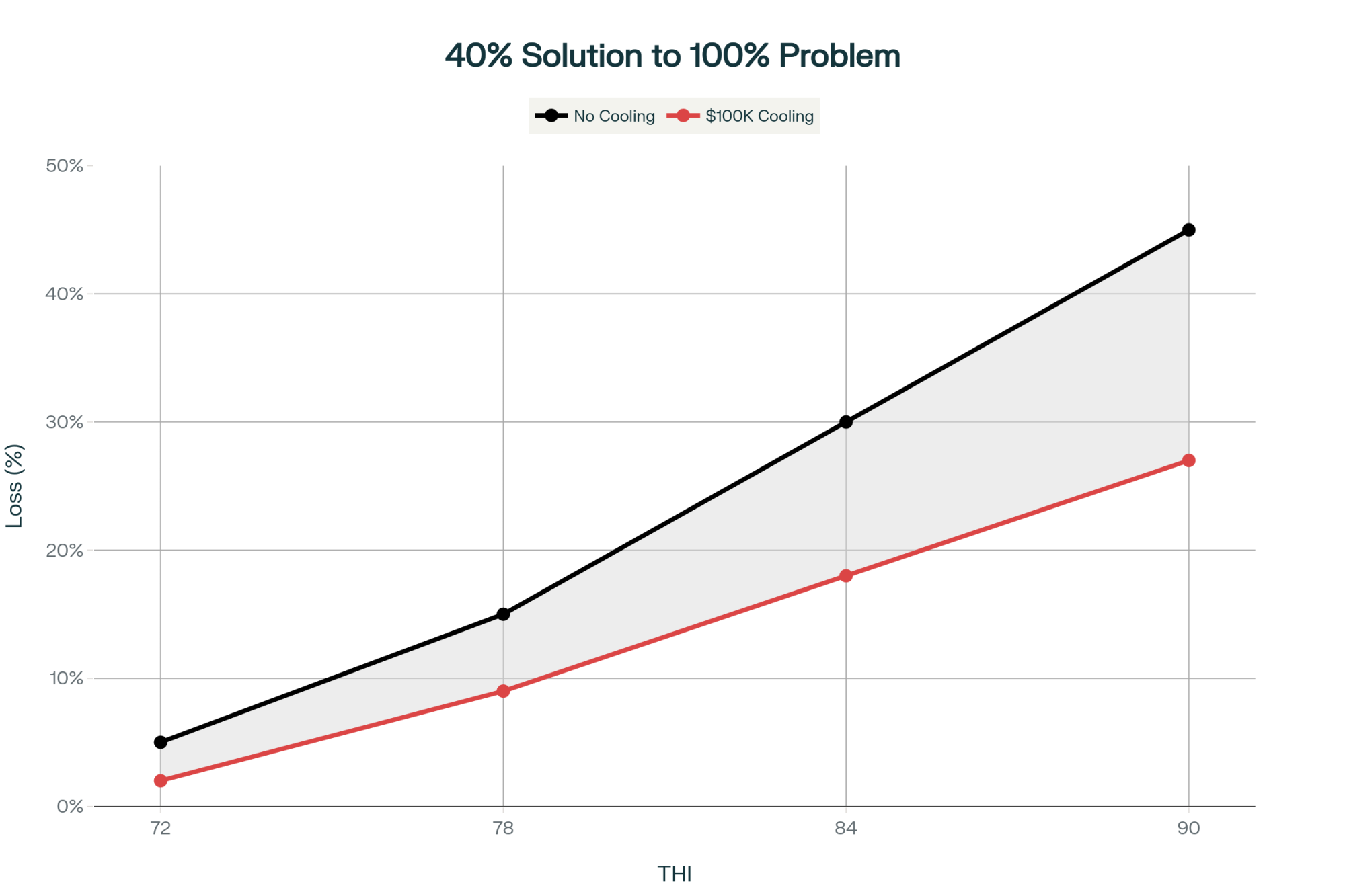
Extension research from multiple land-grant universities reveals cooling systems only mitigate 40% of production losses during extreme heat events. That $100K investment still leaves you bleeding 18-27% production when it matters most—the dirty secret equipment dealers don’t advertise.

What’s particularly challenging is the cash flow math. Farm financial analyses from multiple universities suggest you need fifty to seventy-five thousand in annual free cash to justify that kind of investment. Looking at current milk checks versus input costs… that’s a pretty select group right now.

Many producers tell me the same thing: taking on massive debt for a system that only solves part of the problem feels more like gambling than adapting.

Though I should mention, for some larger operations, the investment does pencil out. Operations with 2,000-plus cows that have invested in comprehensive cooling report maintaining over 90% of their baseline production through heat waves. At that scale, with those milk volumes, the economics can work.
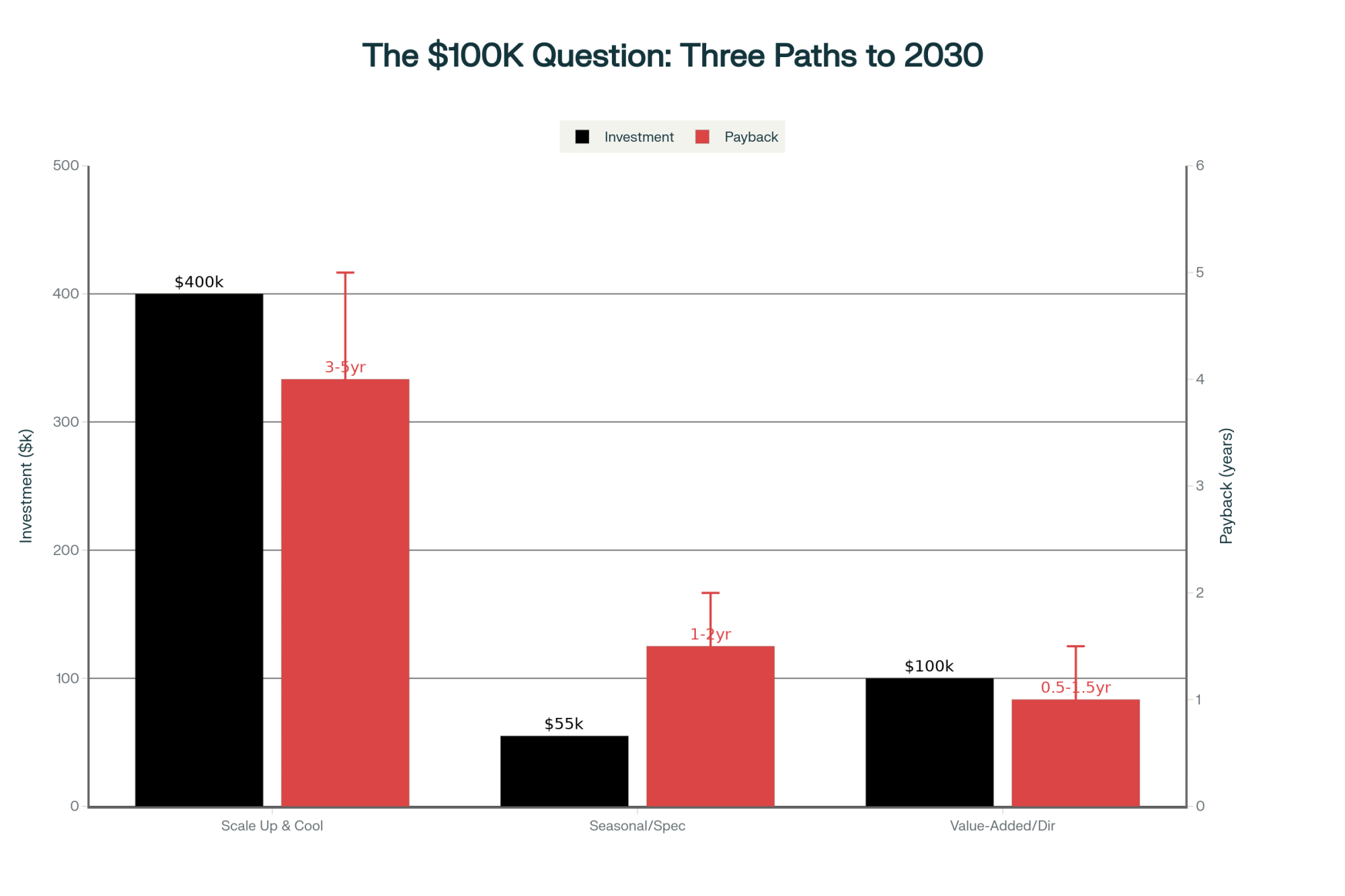
The Italian dairy farmers who invested $50K in cheese vats instead of $100K cooling systems doubled their profits. This chart shows why smaller, strategic investments often outperform mega-tech solutions—a reality North American producers need to face before Q1 2026.

Breeding for the Heat

Before we dive into alternatives, let’s talk genetics—because this is where the future really gets interesting.

Recent research from the USDA and multiple universities shows we’re at a crossroads in heat-tolerance breeding. The good news? Genetic variation for heat tolerance exists, and it’s heritable enough to make selection worthwhile. Studies from Florida show that 13-17% of the variation in rectal temperature during heat stress comes from genetics—that’s lower than milk yield heritability (around 30%), but it’s significant enough to work with.

What’s really eye-opening is how different bulls’ daughters perform under heat. The latest genomic evaluations show that the most heat-tolerant bulls have daughters with 2 months longer productive life and over 3% higher daughter pregnancy rates than the least heat-tolerant bulls. But here’s the trade-off—their predicted transmitting ability for milk is typically 300-600 kg lower, depending on the sire.

University research has identified a critical finding: genetic variance for fertility traits increases under heat stress. This means sire rankings change entirely depending on temperature conditions. A bull whose daughters excel for pregnancy rates in Wisconsin might tank in Texas heat, while another bull’s daughters maintain fertility specifically under stress conditions.

The industry is responding. Genomic evaluation companies now provide heat tolerance indices, with breeding values ranging approximately from minus one to plus one kilogram of milk per day per THI unit increase, according to the latest industry reports. That spread between the best and worst—it’s significant when you’re facing 40 heat stress days.

But here’s what nobody’s talking about openly: the relentless selection for production has made our cows increasingly heat sensitive. Selection indices now include longevity, fitness, and health traits, but we’re still playing catch-up. Progressive producers are prioritizing moderate frame sizes—those efficient 1,350- to 1,500-pound animals that maintain production while handling heat better than the larger frames that were historical breeding targets.

The question is: are you willing to trade some production potential for cows that actually survive and breed back in August? Because that’s the real decision genetics is putting in front of us.

USDA genomic evaluations reveal the genetic contradiction killing herds: bulls whose daughters produce 300-600 kg more milk have daughters that live 2+ months less and show 3% worse pregnancy rates under heat stress. You’re breeding cows that excel in Wisconsin winters but die in August—everywhere

Three Alternatives That Are Actually Working

This is where it gets interesting, because what I’m seeing isn’t theoretical—it’s happening right now on real farms.

Working With the Seasons

The seasonal production model adopted by some Italian producers seemed backward at first. Deliberately dry off cows during peak summer? Accept 25-30% less annual milk? But then you look at the complete picture.

Extension studies from Vermont, Wisconsin, and Michigan show feed costs dropping three to five dollars per cow per day during grazing seasons. Labor needs ease up considerably. And here’s what’s really interesting—market data from various cooperatives shows processors now paying 10-15% premiums for seasonal, grass-based milk. The market’s recognizing quality differences.

I’ve been tracking operations in Vermont and elsewhere that made this shift. Despite producing less milk than year-round neighbors, many report their net income actually increased—sometimes by 20% or more. As one producer put it to me, “When you stop fighting the weather every day, when the cows are comfortable in August, everything changes. The stress level drops for everyone.”

Value-Added on the Farm

Let’s talk about processing, because the economics here can be compelling for the right operation. We all know commodity milk prices—eighteen to twenty dollars per hundredweight when things are decent, less when they’re not. But producers who bottle and sell direct? Industry surveys from the American Cheese Society and extension case studies consistently show returns of $60 to $90 per hundredweight equivalent. That’s not marginal improvement—that’s a different business entirely.

The investment for basic processing ranges from 50 to 100 thousand, about what you’d spend on cooling. But here’s the difference—Penn State feasibility studies and Wisconsin DATCP analyses show that many processors recover that investment in 6 to 12 months when they’ve got their markets lined up.

Operations that have gone this route tell me the aged cheese they make during spring flush can bring ten times what they’d get from the co-op. Ten times. Now, it takes skill, the right permits, and consistent marketing, but for those who make it work, it’s transformative.

Going Direct to Consumers

What’s really changed—and this deserves attention—is the regulatory landscape. The Farm-to-Consumer Legal Defense Fund now tracks over 30 states that permit some form of direct dairy sales. That’s up from basically zero fifteen years ago.

The price differential almost seems unfair to discuss. Raw milk, when it’s legal and properly marketed, sells for $8 to $12 a gallon directly to consumers. Compare that to the $1.80 or $2 equivalent at the farm gate.

What’s encouraging is you don’t need to convert everything. Producers successfully moving just 20% of their milk to direct channels report that it completely changes their financial stability. It’s about diversification that actually means something.

Your Three Pathways: A Quick Comparison

PathwayInvestment RequiredTypical PaybackVolume ChangeBest If You Have…
Scale Up & Cool$300k – $500k3-5 yearsMaintain/IncreaseStrong cash flow, <50% debt
Seasonal/Specialty$30k – $80k1-2 years-25% to -30%Pasture access, flexible mindset
Value-Added/Direct$50k – $150k6-18 months-20% to -30%Market access, marketing skills

The Math of Consolidation is Ruthless

Let’s stop dancing around this. If you’re mid-sized and carrying debt, the climate is coming for your margins—and the numbers don’t lie.

Research from Wisconsin and Cornell agricultural economists identifies the exact break points where your operation becomes a casualty. When your realized milk price consistently runs below eighteen dollars per hundredweight, you’re not adapting—you’re bleeding equity. When income over feed costs drops below seven or eight dollars per cow per day, you can’t service debt anymore. And when debt-to-asset ratios climb above 50%, banks won’t even return your calls for upgrade financing.

These thresholds aren’t suggestions—they’re mathematical realities derived from thousands of farm closures.

Wisconsin’s experience is the canary in the coal mine. USDA-NASS data shows the state hemorrhaged 7,000 dairy farms between 2015 and 2023, yet milk production hit records. Those weren’t random failures—they were mid-sized family operations caught in the consolidation vice. Meanwhile, according to the 2022 Census of Agriculture, operations with over 1,000 cows now control two-thirds of the nation’s milk supply, up from 57% just five years back.

The consolidation winners aren’t shy about it either. Producers who’ve successfully scaled tell me that at 2,000+ cows, they access technology and leverage that transforms the entire business model. As one mega-dairy owner put it bluntly, “Scale gave us options. Everyone else just has hope.”

If you’re sitting at 200 cows with 60% debt-to-asset and milk at $17.50, the math is already written. The question isn’t whether you’ll consolidate or exit—it’s how much equity you’ll have left when you do.

“Sometimes working with natural systems instead of against them might be the smartest strategy of all.”

Three Constraints We’re Not Discussing Enough

Beyond climate and economics, three pressures deserve more attention.

Water Is Everything

The situation with the Ogallala Aquifer has shifted from concerning to critical. U.S. Geological Survey data from 2024 shows that recoverable water continues to decline. Kansas reported drops exceeding a foot across wide areas last year. This directly affects irrigation for feed and long-term dairy viability.

In California, UC Davis research documents that Central Valley groundwater depletion is accelerating beyond sustainable levels. The San Joaquin Valley alone has lost over 14 million acre-feet of groundwater storage since 2019. We’re looking at maybe 15-20 years before water, not heat, determines who stays in business there.

Producers in those regions tell me water is now their first consideration every morning—something their grandfathers never worried about.

Labor Challenges Keep Growing

Industry analyses from the National Milk Producers Federation and Texas A&M converge on this: roughly half of dairy’s workforce consists of immigrant labor, and those workers produce the vast majority of our milk. When you overlay visa challenges and local labor shortages, smaller operations feel it first and hardest.

Rising labor costs—an extra two or two-fifty per cow per month in many areas—that’s often the difference between black and red ink when margins are already tight.

Soil Health Can’t Be Ignored

This might be our biggest long-term challenge. FAO data from 2024, backed by Iowa State research, shows soil organic carbon down by half in many agricultural regions. The fix—regenerative practices—takes three to five years and serious capital before you see results in forage quality.

The operations that most need soil improvement often lack the financial cushion to weather that transition. It’s a tough spot.

Making Your Own Decision

After countless conversations with producers and advisors, certain patterns have emerged to help frame decisions.

Suppose you’re consistently seeing milk prices above eighteen dollars, maintaining income over feed costs above seven or eight dollars per cow per day, keeping debt-to-asset ratios under 50%, and can access three to five hundred thousand in capital. In that case, scaling up with cooling infrastructure might work. But success still requires exceptional management and decent markets.

If those numbers don’t line up but you’re within reach of population centers, have some pasture, and can stomach lower volume for better margins, specialty production models offer real potential. Especially if you can develop that direct channel that provides price stability.

Timing matters. By year’s end, you need an honest assessment. First quarter 2026—decision time. Use 2026-27 for building infrastructure or markets. By 2028-29, you should be transitioning operationally. Come 2030, your model needs to be locked in, because the competitive landscape will be pretty well set by then.

Land-grant research from Cornell, Wisconsin, and Minnesota converges on one truth: you have 5-7 quarters to choose your survival path. Q1 2026 marks the last moment for proactive choice—after that, milk prices, heat waves, and bank covenants make the decision for you. Wisconsin’s 7,000 lost farms learned this the hard way

Regional Realities

RegionCurrent Heat Stress Days2035 Projected Heat DaysWater Crisis SeverityRunway to AdaptCompetitive Advantage
Upper Midwest (WI, MN, MI)12-1520-25StableLongest (~10 yrs)HIGH
Plains States (NE, KS)20-2535-45CRITICAL -1 ft/yrShort (~5 yrs)Declining
California & Southwest30-3545-55EXTREME 140 gal/cowIMMEDIATE (~2 yrs)Collapsing
Northeast (NY, VT)8-1215-20FavorableLong (~12 yrs)HIGHEST
Southeast (GA, FL)40-5060-70ModerateAlready Here (0 yrs)Experience Leader

Upper Midwest

Wisconsin, Minnesota, Michigan—you’ve got the longest runway. University of Minnesota Extension modeling suggests heat stress stays manageable through 2030, and water’s relatively stable. Focus on genetics, targeted cooling in holding areas, and protecting components during stress periods. Current operations average 12-15 heat stress days annually, expected to reach 20-25 by 2035.

Plains States

Nebraska and Kansas dairy operations face a double squeeze—the depletion of the Ogallala Aquifer threatening feed production while heat-stress days increase from the current 20-25 to projected 35-45 by 2040. Kansas State research shows producers here need water strategies yesterday, not tomorrow. Some are already transitioning to dryland-adapted forage systems or relocating operations entirely.

California and the Southwest

Water drives everything here. UC Davis reports show you’re already using 20-30% more water per cow than a decade ago just to maintain production. California dairy operations now consume an average of 140 gallons per cow daily during summer months, up from 95 gallons in 2014. If you haven’t developed a water strategy beyond hoping for wet years, you’re behind. The next five years will force hard choices about value-added production, relocation, or partnering with operations that have water rights.

Northeast

Cornell’s work shows you maintaining favorable conditions through 2035. That’s an opportunity—develop specialty markets now while you have the advantage. The artisan cheese growth in places like the Hudson Valley shows that real market appetite exists. New York State Department of Agriculture reports specialty dairy operations increased 35% between 2022-2024.

Southeast

You’re living tomorrow’s challenges today. Georgia and Florida operations already manage 40-50 heat stress days annually. Every smaller operation surviving your heat and humidity has developed strategies that the rest of us need to study. Your experience is our roadmap.

Resources for Moving Forward

Decision Support Tools:

  • Cornell’s IOFC Calculator (available through the PRO-DAIRY website)
  • Penn State’s Enterprise Budget Tool for processing feasibility
  • USDA Climate Hubs’ regional adaptation resources
  • National Young Farmers Coalition’s direct marketing guides

The Bottom Line

Climate change isn’t just forcing operational changes—it’s driving fundamental shifts in business models. The successful producers I see aren’t trying to preserve yesterday’s approach with tomorrow’s technology. They’re finding what works with emerging realities.

The choice isn’t simply to get bigger or get out. It’s about finding the model that fits your resources, market access, and what lets you sleep at night. For some, that’s scale and technology. For others, it’s lower volume with higher margins through differentiation.

What those Italian dairy farmers are teaching us isn’t that we should all make aged cheese or switch breeds. It’s that one-size-fits-all responses might be less adaptive than thoughtful, farm-specific strategies.

Your operation’s future depends on choosing a path, but mostly on choosing soon enough to control how you implement it. The changes are coming either way.

This is about preserving not just farms but farming as a viable way of life. Sometimes that means producing less to preserve more. Sometimes it means completely rethinking what success looks like.

And sometimes—just sometimes—it means recognizing that working with natural systems instead of against them might be the smartest strategy of all.

Key Takeaways:

  • Cooling = 40% solution to a 100% problem: That $100K system you’re considering? It only stops 40% of losses at extreme temps. Italian farmers who invested in $50K cheese vats doubled their income instead.
  • Three models survive 2030—pick one NOW: Mega-dairy (2,000+ cows), seasonal/specialty (30% less milk, 20% more profit), or value-added (10X commodity prices). Middle ground is extinction.
  • The $18/cwt line divides living from dying: Below it, with >50% debt, you’re already bleeding equity daily. Wisconsin lost 7,000 farms in this death zone while production rose 5%.
  • Genetics force a brutal trade: Accept 500kg less milk for cows that survive August, or chase maximum production with daughters that won’t breed in heat. There’s no middle option.
  • Water kills operations faster than heat: Ogallala Aquifer -1ft/year. California dairy: 140gal/cow/day. Your 2030 survival depends more on water rights than cooling technology.

Complete references and supporting documentation are available upon request by contacting the editorial team at editor@thebullvine.com.

Learn More:

Join the Revolution!

Join over 30,000 successful dairy professionals who rely on Bullvine Weekly for their competitive edge. Delivered directly to your inbox each week, our exclusive industry insights help you make smarter decisions while saving precious hours every week. Never miss critical updates on milk production trends, breakthrough technologies, and profit-boosting strategies that top producers are already implementing. Subscribe now to transform your dairy operation’s efficiency and profitability—your future success is just one click away.
NewsSubscribe
First
Last
Consent

Why Every Smart Dairy Decision Is Driving 14,000 Farms Out – And Your Q1 2026 Action Plan

Every smart dairy decision right now is collectively destroying the industry. 14,000 farms gone by 2027. Your escape plan

EXECUTIVE SUMMARY: Your $1,600 beef-on-dairy calves are funding today’s survival while creating the heifer shortage that will eliminate 14,000 farms by 2027. This isn’t market volatility—it’s structural collapse driven by individual rational decisions creating collective disaster: processors betting $11 billion on milk from cows that don’t exist, heifer inventories at 20-year lows while replacements hit $4,000, and production racing west (Kansas +21%, Wisconsin +2%) where scale economics rule. The timeline is brutal—farms that don’t act before Q1 2026 lose all strategic options. Winners will be mega-dairies leveraging scale, small farms capturing specialty premiums, and operations that exit NOW while equity remains. Mid-size commodity producers face extinction unless they immediately choose: scale up through consolidation, pivot to high-value niche markets, or execute a strategic exit that preserves $200,000-400,000 in family wealth, which disappears after Q1 2026.

Dairy Industry Outlook 2026

You know what’s been keeping me awake lately? It’s not just checking on fresh cows at 2 AM. It’s this strange situation where every producer I talk to—and I mean everyone, from my neighbors here in Wisconsin to folks I met at that Texas conference last month—they’re all making absolutely sensible decisions for their operations. Smart moves, really. Yet somehow, when you add it all up, we’re collectively driving ourselves toward the biggest industry shakeup since the ’80s farm crisis. And here’s what’s wild: this isn’t another milk price cycle we can just ride out. We’re looking at a fundamental transformation that could cut farm numbers from 26,000 to potentially 12,000 within the next 24 months.

The brutal 36-month timeline: 14,000 farms will disappear between now and 2028 – miss the Q1 2026 decision window and you lose all strategic options, joining the forced-exit wave

The Beef-on-Dairy Boom: When Opportunity Becomes a Trap

So here’s what triggered this whole conversation for me. A buddy from Pennsylvania—third-generation dairy farmer, solid operator—texted me last week. He just got $1,600 for a day-old Holstein-Angus cross calf.

I had him repeat that. Sixteen hundred dollars. For one calf.

You probably remember when those same calves were worth maybe $200 on a good day, right? Well, Penn State Extension’s been tracking this closely since earlier this year, and they’re confirming what we’re all seeing—these beef-on-dairy calves are moving for $1,000 to $1,400 pretty consistently across the Northeast. The Wisconsin team’s noting similar numbers out here.

The economic trap that’s destroying dairy: beef-cross calves now fetch $1,600 while replacement heifers hit $4,000 – farmers are cashing checks today that eliminate their industry tomorrow

I was talking with Dr. Michael Hutjens—you might know him from Illinois, he’s been doing some consulting work since retiring—and he put it perfectly. He said that with today’s beef premiums, the income-over-semen-cost calculation has basically rewritten everyone’s budgets. “When crossbred calves fetch double what dairy calves do, you can’t ignore it,” he told me. “But at three, four times? It changes what’s possible on a balance sheet.”

And the math is real. I’ve run these numbers with several neighbors using Cornell’s PRO-DAIRY modeling. Take your typical 500-cow herd, breed about 35% to beef semen—pretty standard approach these days—and you’re looking at $350,000 to $400,000 a year in extra calf revenue. That’s not marketing hype. That’s actual money hitting bank accounts.

But—and here’s where it gets complicated—have you seen what’s happening with heifer inventories? October’s USDA report shows we’re at a 20-year low. Think about that. Only 2.5 million heifers are coming into the US milking herds for 2025. That’s the lowest since they started properly tracking this back in 2003.

The Wisconsin auction yards tell the story. Replacement heifer prices jumped from $1,990 to $2,850 in just one year. And I’m hearing from producers out in the Pacific Northwest—granted, these are the extreme cases—but some folks are paying over $4,000 for the right animal. Even in California, where you’d think the scale would keep things stable, UC Davis Extension is reporting $3,500 for good replacements.

Dr. Victor Cabrera over at Madison said something that really stuck with me: “This makes perfect sense for each individual farm. But system-wide? We’re baking in a heifer shortage that’ll last years.” And you know what? The cull cow numbers tell the same story.

The heifer shortage nobody’s talking about: replacement inventories plummeting from 4.77M head in 2018 to a projected 3.2M by 2027 – a 33% collapse that makes industry expansion impossible

Shifting West: Kansas, Idaho, and the Geography of Expansion

Here’s what’s really fascinating—and honestly, it’s a bit unnerving if you’re farming in traditional dairy states like most of us. The October USDA milk production numbers are eye-opening. Kansas production is up 21% year-over-year. Twenty-one percent! Idaho’s up 9%, Texas jumped 7.4%. Meanwhile, we managed 2.1% here in Wisconsin, and Pennsylvania actually went backwards a bit. Even California, with all those new facilities near Tulare, only grew about 2.4%.

The death of traditional dairy states: Kansas explodes 21% while Wisconsin crawls at 2.1% and Pennsylvania contracts – geography now determines survival more than management skill

This isn’t just random variation, folks. This is a structural change happening right in front of us.

I had the chance to visit a 15,000-cow operation outside Garden City, Kansas, this summer. And what struck me—beyond the sheer scale, which is something else entirely—was the complete integration of every system. They’ve got water reclaim that essentially recycles every drop, hydroponic barley sprouting for year-round fresh feed, and they’re adjusting rations twice daily based on real-time component testing.

The ops manager (he asked me not to use his name because of co-op agreements) shared something interesting. They’re running about $2.50 per hundredweight below the Midwest average on total costs. “It’s not that we’re smarter,” he said. “We just built for this scale from day one. No retrofitting old tie stalls. No working around century-old barn foundations.”

Kansas State’s ag economics folks have been studying this, and they’re confirming these mega-dairies achieve 10% to 15% cost advantages through scale and integration. And yeah, let’s be honest—lower regulatory burden plays a role too.

What’s happening down in Florida and Georgia is different but equally telling. Producers there are dealing with heat stress that would knock our cows flat, but they’re making it work with cross-ventilated barns and genetics explicitly selected for heat tolerance. One Georgia dairyman told me he’s getting 75 pounds per day in August—not Wisconsin numbers, but impressive given the conditions.

Out in New Mexico and Arizona, it’s a different story again. Water scarcity is forcing innovation—one operation near Phoenix installed a reverse-osmosis system that recovers 85% of its water. They’re spending $50,000 annually on water technology, but it’s cheaper than not having water at all. These Southwest operations are proving that you can adapt to almost anything if you’re willing to invest in the right systems.

But here’s what really drives this geographic shift—it’s the processing infrastructure. That new Hilmar plant in Dodge City? It needs 8 million pounds of milk daily. That’s roughly 16 average Wisconsin farms, or about 1.5 of those Kansas mega-dairies. Valley Queen, up in South Dakota, is expanding by 50% to increase capacity, too. The processors go where the milk is, the milk goes where the processors are. It’s self-reinforcing.

The $11 Billion Bet: Processors Defy the Herd Falloff

Here’s a number that should make everyone pause: $11 billion. That’s what the International Dairy Foods Association says processors are investing in new capacity through 2028.

From their perspective, it makes sense. USDA’s November forecasts show milk output reaching 232 billion pounds by 2026, up from 226 billion in 2024. Even with cow numbers staying flat or declining slightly.

Michigan’s posting 2,260 pounds per cow monthly—that’s more than 250 pounds above the national average. Dr. Kent Weigel over at Madison calls this the “component yield era.” We’re seeing 3% to 5% yearly increases in protein and butterfat just from genetics and better feeding. With advances in nutrition, processors are betting on continued supply growth. It’s a reasonable bet based on what we’ve seen historically.

Yet—and this is where things get interesting—CoBank’s August report says we’ll lose another 800,000 heifers before the curve turns around in late 2027. I asked a cheese company exec about this disconnect at last month’s conference. His take? “We’re not betting on more cows. We’re betting on more milk per cow. Frankly, we’d rather work with fewer farms producing consistent volume than coordinate with hundreds of smaller operations.”

What’s interesting is that processors in the Southeast are taking a different approach—smaller, more flexible plants for regional supply. A new facility in North Carolina is designed to handle just 500,000 pounds daily, specifically targeting local specialty markets. But the big money? That’s all, heading to the Plains states.

GLP-1: The Protein Surge Nobody Planned

The obesity drug windfall: GLP-1 users exploding from 41M to 315M creates insatiable whey protein demand – pushing >3.2% protein herds to $1.50/cwt premiums worth $75,000-$100,000 per 500-cow operation

You know what’s wild? The biggest market mover right now isn’t even on the farm—it’s in the pharmacy. Morgan Stanley’s research shows 41 million Americans have tried those weight-loss GLP-1 drugs like Ozempic and Wegovy. The market for these medications is expected to hit $324 billion by 2035.

Why should we care? Well, turns out folks on these drugs need massive amounts of protein to avoid losing muscle along with the weight. The bariatric surgery folks updated their guidelines this year—they’re recommending 1.2 to 2.0 grams of protein per kilogram of body weight for these patients. That’s way above normal recommendations.

Dr. Donald Layman—Professor Emeritus at Illinois, who has been studying protein metabolism forever—told me whey protein’s become the gold standard. “The amino profile and absorption rate match exactly what GLP-1 patients need,” he explained. “You can’t get that efficiency from plant proteins.”

And the market’s responding in real time. CME spot dry whey prices jumped 19.8% in just a month, while Class III and IV are struggling. Lactalis rolled out GLP-1-specific yogurt lines that are flying off shelves. Danone’s high-protein Oikos line posted 40% growth last quarter. Even Nestlé’s getting in on it, developing what they call “next-gen functional proteins” specifically for the weight-loss market.

Here’s what this means for us: a 500-cow herd pushing protein above 3.2% can pocket an extra $50,000 to $100,000annually, just from protein premiums. That’s based on current Federal Milk Marketing Order pay schedules. Real money that could make the difference between red and black ink.

The 24-Month Crunch: Who Exits? Who Thrives?

I’ve been having a lot of conversations lately about survival math. Here’s how I think the next two years play out:

Right now through early 2026: We’re in the “kitchen table decision” phase. A Farm Credit rep in Wisconsin told me they’re seeing two to three times the usual requests for transition planning. “These aren’t distressed operations yet,” he said. “They’re farmers who can read the writing on the wall.”

Spring and summer 2026: That’s when the new processing capacity comes online hard. Valley Queen’s expansion, multiple Texas and Kansas cheese plants. The mega-dairies will lock in those contracts first, leaving mid-size operations scrambling. CoBank expects 3% to 5% of operations to exit during this window. Not all bankruptcies—but hard transitions.

Late 2026 into 2027: Cornell’s Dyson School economists are flagging rapid compression—25% to 40% of milk could come from operations over 5,000 cows. Dr. Andrew Novakovic at Cornell compared it to the ’80s consolidation, but compressed. “What took ten years then is happening in two or three now,” he told me.

2027-2028: We’ll likely stabilize at 12,000 to 18,000 farms total, down from today’s 26,000. The rest get absorbed or shut down.

What This Means for Different Operations

So what’s a producer to do? Well, it depends on your situation.

If you’re running a mega-dairy (5,000+ cows): Your advantages are clear—scale, technology, processor relationships. Just don’t overleverage. Keep debt under 40% of assets—that’s what saved the survivors in 2009 and 2020. And plan for those beef-on-dairy premiums to drop back to $400-500 when the beef herd rebuilds. It always does.

If you’re mid-size (500-2,000 cows): This is where it gets tough. If you’re losing money on milk alone, that beef-on-dairy revenue is buying time, not solving problems. Gary Sipiorski at Vita Plus puts it bluntly: “Q1 2026 is your decision window.” Exit while you have equity, find a niche, or partner up for scale.

I’ve seen success stories from Northeast operations doing direct sales, some Georgia and Texas folks making it work with heat-tolerant crossbreeds and targeted butterfat contracts. Down in Arizona, several mid-size operations formed a marketing co-op specifically for premium contracts. There are paths forward, but they require decisive action.

If you’re smaller (under 500 cows): Don’t write yourself off. Direct sales, on-farm processing, high-premium markets like A2 or grassfed with strong local brands—these can work if you’re committed. Bob Cropp at Madison always says, “Niche isn’t enough—you need real differentiation and usually some off-farm income during transition.”

The Stuff That’s Not in the Spreadsheets

Mental health matters here. Every banker I talk to mentions family stress. The Wisconsin Farm Center offers free, confidential counseling. Minnesota has their Farm & Rural Helpline (833-600-2670). Iowa State Extension runs Iowa Concern (800-447-1985). Most states have similar programs—find yours and use it. I’ve seen too many good operators make bad decisions because stress clouded their judgment.

Policy risk is real. Don’t build a five-year plan assuming today’s Dairy Margin Coverage program or immigration rules stick around. They won’t. Build flexibility into your planning.

Water—if you’re in the Southwest, plan for 30% cuts in availability by 2030. That’s what the Bureau of Reclamation models suggest. I talked to a Central Texas dairyman who’s already hauling water weekly, and another in New Mexico who’s paying $200 per acre-foot—triple what he paid five years ago. Changes everything about your cost structure.

And technology disruption? Precision fermentation isn’t science fiction anymore. Fonterra just put $50 million behind it. Perfect Day is already selling ice cream made with lab-produced dairy proteins. We can’t ignore this stuff.

Looking Forward: Building Smart AND Resilient

What I keep asking myself is—are we optimizing for the wrong things? Dr. James Dunn at Penn State warns that stable conditions reward efficiency, but what happens when things get less stable?

I think adaptability wins. The operations that’ll thrive in 2028 won’t necessarily be the biggest or most efficient. They’ll be the ones with options—not all-in with one processor, not overleveraged, not betting everything on one market.

Watch what’s happening in Europe with their farm protests. See New Zealand fighting environmental regulations. Australia’s dealing with drought cycles that make our weather look predictable. No export market is guaranteed. No playbook survives every storm.

The Bottom Line

If there’s one thing I’d leave you with, it’s this: the window for proactive decisions—whether that’s expansion, exit, or complete restructuring—is closing faster than most of us realize. By Q1 2026, most of the good options will be taken.

Push for higher components, not just volume. Be realistic about calf prices. Know your regional advantages—whether that’s proximity to processors in Kansas or grassfed premiums near Boston. And don’t try to go it alone. Get good advice. Run real numbers. Have honest conversations with your family.

The industry isn’t dying, but it is shedding its skin. Make sure you aren’t the one shed with it.

Your state’s Farm Center or Extension can help—Wisconsin’s is free and confidential (800-942-2474). Farm Aid runs a national hotline at 1-800-FARM-AID. The National Suicide Prevention Lifeline (988) has agricultural specialists available. Sometimes the hardest conversation is the one that saves your farm—or helps you exit with dignity and equity intact.

KEY TAKEAWAYS

  • Decision Deadline: Q1 2026 – After this, you lose all strategic options. Exit now = $200-400K preserved equity. Exit later = bankruptcy.
  • Immediate Revenue: Chase Protein Premiums – Getting above 3.2% protein captures $50-100K annually (500 cows) from GLP-1 demand while you plan next moves.
  • Reality Check Your Business – If you need $1,600 beef calves to survive, you’re already dead. Plan for $500 calves, $15 milk, and 30% less water (Southwest).
  • Only 3 Models Survive – Mega-scale (5,000+ cows), radical differentiation (A2, grassfed, on-farm processing), or strategic exit. “Local” and “family farm” aren’t differentiators.
  • Geographic Destiny – Kansas/Idaho/Texas have won. Traditional dairy states face a permanent 15% cost disadvantage. Location now determines survival more than management.

Complete references and supporting documentation are available upon request by contacting the editorial team at editor@thebullvine.com.

Learn More:

Join the Revolution!

Join over 30,000 successful dairy professionals who rely on Bullvine Weekly for their competitive edge. Delivered directly to your inbox each week, our exclusive industry insights help you make smarter decisions while saving precious hours every week. Never miss critical updates on milk production trends, breakthrough technologies, and profit-boosting strategies that top producers are already implementing. Subscribe now to transform your dairy operation’s efficiency and profitability—your future success is just one click away.

NewsSubscribe
First
Last
Consent

How Structural Changes Are Shaping the Future of Germany’s Dairy Industry

How are structural changes impacting Germany’s dairy industry, and can sustainable practices keep it the EU’s top milk producer?

Summary:

Germany’s dairy sector, a long-standing agriculture pillar, is experiencing transformative changes, reshaping farm numbers, cow populations, and milk production and export volumes. Challenges like generational shifts, market volatility, and evolving environmental standards test this critical industry, yet resilience persists with increased herd sizes and sustainability goals coming to the forefront. With 46,600 commercial dairy farms as of 2023, Germany’s dairy industry remains the most significant domestic food sector despite declines due to generational gaps, economic pressures, and environmental challenges. Export reliance and domestic consumption are essential, with historical shifts and strategic innovation prompting consolidation and larger farms, particularly in eastern states. The 2015 milk quota abolition marked a crucial turning point, posing concerns for small, family-run farms. Sustainability and animal welfare have become central focuses, underscoring the sector’s commitment to maintaining agricultural excellence amid change.

Key Takeaways:

  • Germany’s dairy industry remains a crucial player in the EU, consistently demonstrating resilience despite declining numbers of farms and cows.
  • Structural changes are driven by generational gaps and economic challenges, impacting smaller farms disproportionately.
  • Milk production has increased even as farm numbers decline, reflecting a shift towards fewer, more extensive operations.
  • The abolition of the milk quota in 2015 altered market dynamics, amplifying price volatility and competitiveness.
  • Germany maintains a strong export market, particularly for cheese, with significant trade relationships within and outside the EU.
  • Sustainability and animal welfare are becoming increasingly important factors in the dairy sector’s future strategies.
  • The ongoing transformation of the dairy industry raises questions about Germany’s future position as the EU’s largest milk producer.
  • Policy changes and their communication are critical in shaping industry dynamics and managing conflicts.

Have you ever considered what makes Germany’s dairy sector a powerhouse within the European Union, not just a cornerstone of its economy? As we delve into the intricate web of structural changes reshaping this robust industry, one thing becomes clear: Germany’s dairy scene is not merely weathering challenges; it’s transforming them into opportunities. “German agriculture leans heavily on milk production, a sector that doesn’t just feed the nation but drives the gears of its gargantuan food industry.” But what are these changes really about? Are they threats to tradition or stepping stones to a sustainable future? Join us as we explore how historical shifts and strategic innovation compose a new narrative for Germany’s dairy arena. Let’s dive into why this matters to every farmer, retailer, and consumer involved. 

Germany’s Dairy Juggernaut: Resilience Against Decline 

Germany’s dairy industry is the cornerstone of its agriculture and the largest sector within the country’s robust food industry. Germany leads the EU in milk production, underscoring its pivotal role in national and continental contexts. As of 2023, the nation boasts around 46,600 commercial dairy farms, starkly contrasting to the 138,500 farms recorded at the millennium turn of the millennium. Despite this reduction in the number of farms, milk production has showcased resilience and growth, with a record 33.1 million kg produced in 2020. 

To emphasize the industry’s stature, milk accounts for nearly 18.9% of Germany’s agricultural production value, a testament to its economic significance. This sector caters to domestic consumption and heavily relies on export markets, magnifying its global importance. Strategic adaptation to global market pressures has made German dairies more concentrated and efficient, with average farms growing more extensive over the years—a clear indicator of their pursuit of economies of scale in an increasingly competitive marketplace. 

Generational Gaps and Economic Strains Reshape Germany’s Dairy Horizon

Over recent decades, Germany has witnessed a stark decline in dairy farms and cows. This transformation within the dairy farming landscape can be primarily attributed to generational shifts, economic pressures, and environmental challenges. 

Generational shifts have played a significant role. The lack of farm succession from generation to generation has left many farms without heirs willing to continue the labor-intensive work of dairy farming. Economic pressures have exacerbated this trend, where larger farms have become more viable through economies of scale than smaller operations. The volatility of the global milk market has only added to the precariousness, often squeezing smaller farms out of competition. 

Environmental challenges have further compounded these issues. With increasing scrutiny on animal welfare and the environmental impact of farming practices, many smaller farms struggle to meet the necessary standards and certifications without substantial investment, which is often not feasible. 

Meanwhile, the increase in farm size has been marked, reflecting a trend toward consolidation. Farms that withstand these pressures often expand, significantly increasing the average number of cows per farm. Notably, regional variations are evident. In eastern German states, farms tend to have larger herds, typically between 150 and 240 cows, compared to the southern states, where farms are smaller, with an average of 45 to 60 cows. 

This structural shift underscores the broader trends in agriculture. It reflects a move towards efficiency and scale but also highlights the critical challenges that must be addressed to ensure the dairy sector’s sustainability.

The Impact of Milk Quota Abolition: A Catalyst for Change in Germany’s Dairy Industry 

The phasing out of the milk quota system in 2015 marked a significant turning point for Germany’s dairy sector. This policy shift and the EU’s Common Agricultural Policy (CAP) reforms thrust the industry into a highly competitive and volatile global market. Without the quota’s stabilizing effect, dairy farmers were navigating a landscape where supply and demand dictated their livelihoods. This exposure to market forces required a recalibration of operational strategies. 

The result? A wave of consolidation rippled through the industry. As smaller farms struggled to maintain profitability, more extensive and technologically advanced operations began dominating. The dairy sector’s structural evolution was about survival and thriving in an environment where efficiency and scale became paramount. 

Moreover, the newfound market dynamism amplified price volatility. This double-edged sword could lead to record highs and punishing lows. This unpredictability forced dairy producers to rethink their risk management approaches. For some, it meant expanding into value-added products; for others, it involved honing in on efficiency to squeeze every possible penny of profit from each liter of milk. 

Market liberalization and competitive pressures have undoubtedly reshaped Germany’s dairy landscape. As farms become more sophisticated, they are better equipped to weather global market fluctuations. Yet, this transformation also raises the question: Will this quest for efficiency come at the expense of the small, family-run farms that have been the backbone of rural economies?

Germany’s Dairy Export Powerhouse: Navigating Consumption Shifts 

It’s no secret that changing consumer behaviors have impacted Germany’s dairy sector. Have you ever wondered why people consume less milk, yet cheese remains in high demand? Per capita milk consumption in Germany has markedly decreased over the years, resting at just 45.8 kg per person in 2023. Interestingly, these figures tell a story of overabundance, with self-sufficiency for milk reaching 107%. 

It is worth noting Germany’s prowess as a leading net exporter. Germany has consistently maintained a stronghold on international dairy markets, especially cheese. The numbers speak for themselves: approximately half of the milk produced in Germany is exported, culminating in a staggering 1.4 million tonnes of cheese sent to international destinations in 2023 alone. 

The European Union remains a key market. Italian, Dutch, and French consumers are among the top aficionados of German cheese. Meanwhile, on the global stage, nations like the United Kingdom, Switzerland, Japan, and South Korea have developed a pronounced appetite for these exports. Foreign trade is a linchpin of the German dairy sector, strategically positioning Germany as a pivotal player in the global dairy arena. 

Given these dynamics, do you think Germany will continue to lead the pack? Or will emerging markets and changing consumer preferences disrupt this balance? The future is ripe with possibilities and challenges. Share your thoughts in the comments below. 

Sustainability and Animal Welfare: Redefining Germany’s Dairy Future

Sustainability and animal welfare have undeniably become focal points in Germany’s dairy sector, and the momentum is only intensifying. With increasing scrutiny from the public and policymakers, the call for responsible and ethical dairy farming practices is loud and clear. This shift isn’t just about being eco-friendly; it’s about redefining what it means to be a dairy farmer in the contemporary world. 

One of the most ambitious initiatives has been the push towards pasture-based systems. Transitioning to pasture-raised milk—which necessitates that cows graze for at least six hours a day across 120 days annually—aims to enhance the quality of life for dairy cows. While this change resonates well with consumers willing to pay a premium for ethically sourced products, it poses significant financial and operational challenges for farmers. The bonus from dairies for meeting these criteria often falls short of covering the extra costs incurred. 

Moreover, organic milk production is gradually gaining traction in Germany. Although representing just 4.5% of total milk output, the sector’s slow but steady growth highlights a pivot towards more sustainable methods. Again, this transition comes with challenges. The costs associated with organic certification and the need for alternative farming practices often deter many farmers despite the potential for higher market prices. 

Ultimately, the journey towards heightened sustainability and animal welfare is far from straightforward. While the intentions and goals align with climate change discussions and ethical farming practices, the economic repercussions and operational strains cannot be ignored. As Germany strives to sustain its leading status in the EU dairy sector, it must balance these ideals with practical solutions that support farmers in this evolution.

Germany’s Dairy Sector: Navigating the Crossroads of Modern Agricultural Demands and Market Dynamics

Germany’s dairy sector is at a crossroads as it navigates the evolving landscape of agricultural production and market demands. With structural changes reshaping the industry, Germany’s position as the EU’s largest milk producer is under scrutiny. The transformation is a question of scaling, sustainability, and strategic global engagement. 

Export dynamics have long buoyed Germany’s dominance, with nearly half of its milk production exported. However, this reliance on global markets introduces vulnerabilities, especially amid geopolitical tensions and fluctuating trade relations. Maintaining this export prowess demands continuous adaptation, ensuring that German dairy products remain competitive and sought-after internationally. This involves balancing quantity and quality and aligning with global food safety and sustainability standards. 

Domestically, demand patterns are shifting. The decline in per capita consumption poses a challenge, urging the industry to innovate and diversify its product offerings to capture consumer interest. While domestic self-sufficiency rates are high, which is economically advantageous, there’s a constant push for consumer engagement and market expansion within Germany to ensure robust internal demand. 

Sustainability practices are increasingly at the heart of the dairy industry’s strategies. With the public and legislative focus on environmental impact, Germany’s dairy farmers will likely face stringent regulations and expectations. While sustainability can be challenging in terms of cost and implementation, it can also act as a differentiator in the market, aligning Germany with the global movement towards eco-friendly production. 

Germany’s ability to remain the EU’s dairy titan will likely depend on its agility in adapting to structural shifts. The industry must strategically leverage its export strengths, address domestic consumption nuances, and embed sustainable practices into its core operations. It must balance modernizing its approach with preserving the traditional essence that makes German dairy distinct.

The Bottom Line

Germany’s dairy sector has demonstrated remarkable resilience amidst transformative changes. Despite a significant decline in the number of farms and dairy cows, milk production has increased thanks to improved efficiency and more prominent, focused operations. The abolition of the milk quota has further intensified market pressures, ushering in a new era of competition and price volatility. 

Export powerhouses, particularly in cheese, continue to buoy the industry, although shifts in local consumption patterns pose challenges. Given mounting environmental concerns and evolving consumer expectations, the push for sustainable and ethical farming practices is no longer optional but essential for industry longevity. 

As you reflect on Germany’s dairy journey, consider the following: How can smaller farms adapt to stay competitive in an increasingly globalized marketplace? What role will technological innovations play in aligning productivity with ecological responsibility? Will Germany maintain its leading position in European milk production, or will emerging markets redefine the landscape? I’d love to hear your thoughts and predictions on these pressing issues. Please feel free to comment below and share this article with others who might find it valuable! 

Learn more:

Join the Revolution!

Bullvine Daily is your essential e-zine for staying ahead in the dairy industry. With over 30,000 subscribers, we bring you the week’s top news, helping you manage tasks efficiently. Stay informed about milk production, tech adoption, and more, so you can concentrate on your dairy operations. 

NewsSubscribe
First
Last
Consent
Send this to a friend





