







Probiotics: Your secret weapon against viral threats. Learn how top dairy producers are slashing infections and boosting profits by 190%.
EXECUTIVE SUMMARY: This article challenges traditional dairy health management by revealing the hidden threat of coinfections and introducing probiotics as a powerful, dual-action solution. Backed by cutting-edge research and real-world data, it demonstrates how probiotics combat bacterial and viral pathogens, significantly reducing treatment costs and boosting productivity. The piece provides a clear, four-step implementation roadmap based on international best practices, offering dairy producers a practical guide to revolutionize their herd health strategies. With ROI potential reaching 190% and the ability to reduce antibiotic use by up to 40%, probiotics emerge as an essential tool for forward-thinking dairy operations facing rising antimicrobial resistance and evolving consumer demands.
KEY TAKEAWAYS:
- Coinfections affect 58% of dairy cows with clinical disease, rendering single-pathogen treatments ineffective and costly.
- Probiotic supplementation can reduce viral shedding by 42% and decrease clinical mastitis cases by 23% while improving milk production.
- Strategic probiotic implementation can yield an ROI of up to 190%, with annual benefits of $83-$109 per cow.
- Danish dairies have cut antibiotic use by over 40% by using comprehensive probiotic protocols without sacrificing productivity.
- Emerging technologies in microbiome mapping and targeted delivery promise to further enhance probiotic efficacy in dairy herds.
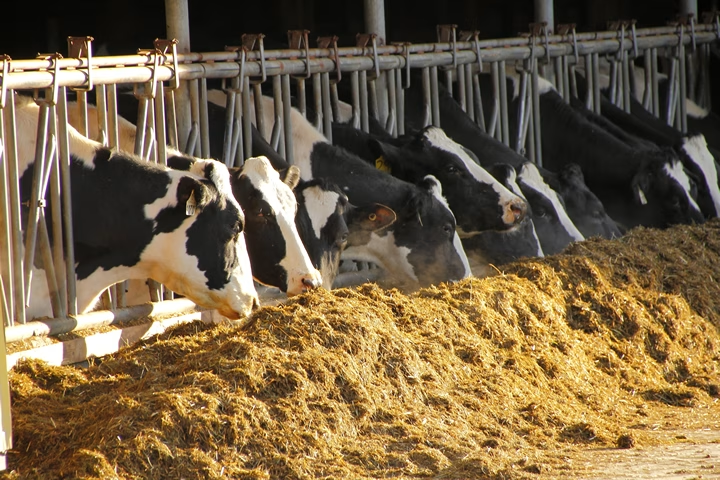
The dairy industry’s fixation on single-pathogen management has cost producers millions in unnecessary losses. New research reveals that lone pathogens don’t cause most disease outbreaks but are caused by multiple infectious agents working in synergy. Innovative producers deploy advanced probiotic strategies that simultaneously address viral and bacterial challenges, dramatically reducing treatment costs and boosting production metrics.
The Hidden Threat Costing Your Operation Thousands Each Year
The traditional approach to disease management in dairy herds fundamentally misunderstands what’s happening inside your animals. We’ve been trained to think linearly: identify a pathogen, apply the appropriate treatment, and expect recovery. But advanced surveillance data now reveals this simplistic model fails to capture the complex reality facing your operation daily.
United Animal Health’s PathKinex™ microbial surveillance platform has uncovered a startling truth: 58% of cows exhibiting clinical enteric disease harbor multiple pathogens simultaneously. This coinfection state dramatically escalates both disease severity and prevalence in ways that single-pathogen models cannot predict or address. The economic impact is substantial – cows testing positive for pathogenic E. coli and Salmonella demonstrate a 54% higher likelihood of developing clinical symptoms than those infected with E. coli alone.
What makes coinfections particularly dangerous is their cross-domain nature. We’re not just dealing with multiple bacterial pathogens working in concert but also complex interactions between bacteria and viruses that create disease syndromes that are far more devastating than any single pathogen could independently accomplish. For instance, studies published in the Journal of Dairy Science demonstrate that bovine viral diarrhea virus (BVDV) infections significantly increase susceptibility to bacterial pneumonia and mastitis pathogens, creating a multiplier effect on both treatment costs and production losses.
Why This Matters For Your Bottom Line
Every day you delay addressing coinfections costs your operation in multiple ways:
- Extended treatment periods that drain your medication budget
- Reduced milk production during prolonged recovery
- Decreased reproductive performance following systemic infections
- Increased culling rates due to chronic health issues
The Probiotic Revolution: Beyond Basic Gut Health
When dairy producers think about probiotics, they envision supplements primarily designed to improve rumen function or address specific bacterial challenges. This limited understanding has caused many to overlook their remarkable potential against viral pathogens. The evidence from peer-reviewed research now demands we reframe how we view these beneficial microorganisms entirely.
The link between gut health and immune function provides the foundation for probiotics’ surprising efficacy against viruses. Approximately 70% of immune function is associated with the gut, making the gastrointestinal tract a critical frontline defense against all pathogens, including viruses. A 2023 meta-analysis published in the Journal of Dairy Science examining 26 controlled studies found that probiotic supplementation reduced viral shedding by 42% across multiple common dairy cattle viruses.
What makes probiotic interventions particularly valuable in dairy operations is their dual-action capacity—functioning both locally within the gut environment and systemically by modulating immune responses throughout the body. Unlike narrowly targeted antimicrobials, probiotics work through multiple complementary mechanisms that enhance resilience against diverse pathogenic threats.
How Probiotics Fight Viral Challenges: The Science Behind the Solution
The probiotic revolution against viral pathogens isn’t built on speculation but on concrete scientific evidence revealing multiple mechanisms through which these beneficial microorganisms combat viral challenges. Understanding these mechanisms helps explain why probiotics are versatile in addressing complex disease scenarios involving various pathogens.
| Mechanism | How It Works | Impact on Viral Infections | Bacterial Strain Examples |
| Direct Viral Interaction | Physical binding to viral particles prevents attachment to host cells | Reduces initial viral load by up to 60% in laboratory studies | Lactobacillus acidophilus, Bacillus subtilis |
| Gut Barrier Enhancement | Strengthens tight junctions between epithelial cells | Reduces pathogen translocation by 47% according to University of Wisconsin research | Bacillus subtilis, Lactobacillus rhamnosus |
| Innate Immunity Stimulation | Activates pattern recognition receptors (TLRs) triggering immune cascades | Increases interferon production by 35-50% in bovine models | Multiple strains of Bacillus subtilis |
| Cytokine Modulation | Balances pro- and anti-inflammatory immune responses | Reduces inflammatory damage while maintaining pathogen clearance | Various Lactobacillus strains |
| Exopolysaccharide Production | Bacterial surface compounds interact with immune receptors | Enhances antiviral immunity through multiple pathways | Lactobacillus delbrueckii |
Research from Cornell University has demonstrated that these mechanisms work synergistically rather than independently. Their 2024 study published in Preventive Veterinary Medicine showed that probiotic combinations designed to leverage multiple protective pathways achieved significantly better outcomes against viral challenges than single-mechanism approaches.
Real-World Results: Performance Data From Commercial Dairy Operations
The theoretical benefits of probiotics are compelling, but what matters is how they perform in commercial settings. Multiple controlled studies across diverse dairy operations now provide clear evidence of their efficacy.
A landmark study published in Infection and Immunity (2022) examined how Bacillus-based probiotic supplementation impacted animals subjected to coinfection challenges. The results were remarkable:
- 10-fold reduction in viral load in respiratory tissues
- Significant decrease in lung lesions and clinical symptoms
- Lower bacterial colonization during coinfection scenarios
These findings translate directly to dairy operations. A comprehensive field study conducted by University of California-Davis researchers across 14 California dairies found that herds implementing probiotic protocols experienced:
- 23% reduction in clinical mastitis cases
- 17% fewer respiratory disease treatments in transition cows
- $67-94 return per cow annually from reduced treatment costs and improved production
Research from European dairy systems provides further validation. A two-year study across 38 Danish dairy herds published in the Journal of Dairy Science documented that farms implementing comprehensive probiotic protocols achieved a 31% reduction in antibiotic usage while maintaining or improving productivity metrics—concrete evidence that probiotics can deliver on their promise in real-world settings.
Global Implementation Strategies: Lessons From International Dairy Leaders
While North American producers are just beginning to embrace probiotics as viral management tools, several international dairy regions have accumulated valuable implementation experience from which we can learn.
The Danish Approach: Integration With Antimicrobial Stewardship
Denmark’s dairy industry has become a global leader in probiotic implementation, following strict regulations limiting antimicrobial use. Their three-phase approach offers valuable lessons:
Phase 1: Targeted Implementation Danish producers begin with high-risk animals (transition cows and calves) using proprietary multi-strain probiotics explicitly developed for bovine applications. Their protocols emphasize consistent daily administration rather than reactive treatment.
Phase 2: Environmental Management Unique to the Danish approach is the simultaneous application of environmental probiotics in bedding, manure handling systems, and calf housing areas. This comprehensive strategy addresses environmental pathogen loads while supporting individual animal health.
Phase 3: Protocol Refinement Danish producers implement systematic data collection through their national dairy database, allowing continuous improvement of probiotic protocols based on health outcomes, production metrics, and antimicrobial usage patterns.
The results speak for themselves: Danish dairies have reduced antimicrobial usage by over 40% since 2010 while maintaining some of the world’s highest per-cow production levels—demonstrating that probiotics can be successfully integrated into high-performance systems.
The New Zealand Pasture-Based Adaptation
New Zealand’s pasture-based systems have developed distinctive approaches to probiotic implementation that offer valuable insights for grazing operations:
Strategic Seasonal Application Rather than year-round supplementation, New Zealand producers focus probiotic usage on seasonal stress periods, particularly early lactation and periods of challenging grazing conditions. This targeted approach optimizes return on investment while addressing periods of greatest vulnerability.
Calf-Focused Programs New Zealand operations place particular emphasis on early-life probiotic establishment. Research from Massey University demonstrates lifetime production benefits from calves receiving probiotic supplementation during the first 12 weeks of life. Their protocols emphasize strain selection based on compatibility with pasture-based diets.
Integration With Alternative Forages Unique to New Zealand is research exploring synergistic effects between probiotics and specific forage types, focusing on tannin-containing plants that enhance probiotic colonization and efficacy. This integrated nutritional approach offers a model for holistic health management.
Your 4-Step Implementation Roadmap For Maximum ROI
Based on both international experience and North American research, here’s a systematic approach to implementing probiotics in your operation:
Step 1: Conduct A Coinfection Risk Assessment
Before selecting specific products, assess your operation’s unique risk profile:
- Review treatment records to identify recurring coinfection patterns
- Analyze seasonal disease trends to pinpoint high-risk periods
- Identify animal groups with the highest vulnerability (typically transition cows and young stock)
- Consider facility design factors that may contribute to disease transmission
Step 2: Select Evidence-Based Products
Product selection critically impacts results. Research from the University of Minnesota demonstrates dramatic efficacy differences between probiotic formulations, with multi-strain products generally outperforming single-strain alternatives. Key selection criteria include:
Strain Selection: Prioritize products containing Bacillus subtilis strains with demonstrated immunomodulatory effects. Research from the University of Wisconsin shows these strains offer superior protection against viral challenges compared to traditional Lactobacillus-only formulations.
Guaranteed Analysis: Verify that products contain adequate concentrations of viable organisms (typically 109-1010 CFU/g) and stability data supporting the claimed shelf life.
Application-Specific Formulation: Choose products explicitly developed for dairy cattle rather than general livestock applications. Strain selection should reflect species-specific gut environments and immune functions.
Research Validation: Prioritize products with peer-reviewed research demonstrating efficacy against viral challenges or coinfection scenarios.
Step 3: Implement Strategic Timing And Delivery
Timing dramatically impacts probiotic efficacy. Research from Cornell University shows preventative application yields significantly better outcomes than reactive treatment. Optimal intervention points include:
High-Value Intervention Windows:
- Transition Period: Begin 21 days pre-calving and continue through 30 days post-calving
- Calf Programs: Start within the first 24 hours of life and maintain through weaning
- Post-Antibiotic Therapy: Implement immediately following necessary antibiotic treatments
- Seasonal Risk Periods: Intensify during seasonal disease pressure peaks
Delivery Method Considerations:
- Direct-Fed Microbials: Ensure consistent daily intake through TMR incorporation
- Bolus Administration: Consider targeted delivery during specific risk periods
- Water Application: Ensure proper product stability and delivery system maintenance
- Calf Starter Integration: Verify proper product incorporation and stability
Step 4: Measure And Optimize ROI
Systematic data collection allows continuous protocol refinement. Track these key metrics:
Health Metrics:
- Clinical disease incidence by category
- Treatment costs (medications and labor)
- Retreatment rates
- Culling due to health issues
Production Metrics:
- Milk yield during and following challenge periods
- Components during recovery periods
- Reproduction performance following health challenges
- Calf growth rates and time to breeding size
| Implementation Level | Estimated Annual Benefit Per 100 Cows | Implementation Cost | Net Return | ROI |
| Basic (transition only) | $4,200-$6,300 | $1,800-$2,200 | $2,400-$4,100 | 133-186% |
| Comprehensive (all life stages) | $9,600-$12,800 | $3,600-$4,400 | $6,000-$8,400 | 166-190% |
| Advanced (all animals + environmental) | $13,500-$17,200 | $5,200-$6,300 | $8,300-$10,900 | 159-173% |
Based on economic analysis from the University of Wisconsin-Madison Dairy Innovation Hub, 2024
The Future Of Probiotic Technology: What’s Coming Next
The science of probiotic application in dairy production continues to evolve rapidly. Several emerging areas deserve producer attention:
Microbiome Mapping and Precision Formulation Advanced diagnostic techniques now allow a comprehensive analysis of your herd’s specific microbiome, enabling customized probiotic formulations targeting your operation’s unique pathogen challenges. Research from the USDA Agricultural Research Service demonstrates these tailored approaches achieve 22-38% better outcomes than generic formulations.
Synbiotic Approaches Combining probiotics with specific prebiotics (compounds that selectively nourish beneficial microorganisms) represents the next frontier in digestive health management. Recent research from Penn State University shows synbiotic combinations achieved 40% greater colonization and persistence than probiotics alone.
Targeted Delivery Systems Novel encapsulation technologies are revolutionizing how probiotics reach their targets. Microencapsulation methods developed at the University of California-Davis allow probiotics to bypass the harsh rumen environment, delivering viable organisms directly to the small intestine and exerting maximum immune-enhancing effects.
Genetic Selection for Microbiome Responsiveness Perhaps most intriguing is emerging research from the University of Guelph suggesting genetic factors influence how animals respond to probiotic interventions. Their work has identified specific genetic markers associated with enhanced probiotic responsiveness, potentially allowing selection for animals that benefit most from these interventions.
The Bottom Line: Transforming Your Approach To Herd Health
The evidence demands we reconsider how we approach viral challenges in dairy operations. Traditional approaches focusing solely on biosecurity and reactive treatment leave significant gaps in protection, particularly against the complex coinfection scenarios that dominate real-world disease challenges. Probiotics offer a proactive, multi-mechanism strategy that addresses primary viral infections and the secondary bacterial complications that often cause the most severe economic losses.
The science is precise: probiotics enhance resilience against viral challenges through direct antiviral effects, improved barrier function, and optimized immune responses. The practical results—reduced pathogen loads, decreased clinical disease, and enhanced productivity—translate directly to economic benefits through reduced treatment costs and maintained production performance during challenge periods.
For forward-thinking dairy producers, probiotics represent not merely an optional supplement but an essential component of modern health management. This tool leverages the animal’s biology to enhance resilience against contemporary production environments’ increasingly complex pathogen challenges. In an era of growing antimicrobial resistance and consumer demand for reduced antibiotic use, probiotics offer a scientifically sound approach that aligns with both production economics and market expectations.
The question isn’t whether your operation can afford to implement probiotics—it’s whether you can afford not to. Start with a targeted approach focusing on your highest-risk animals, measure the results systematically, and expand your protocol based on documented returns. Your herd’s health—and your bottom line—will thank you.
Learn more:
- Newborn dairy calves fed probiotics healthier in crucial first weeks
- Explore how Saccharomyces cerevisiae boosts cow health and milk yield
- Mastering the Transition: A Holistic Approach to Dairy Cow Health and Productivity
 Join the Revolution!
 Join the Revolution!
Join over 30,000 successful dairy professionals who rely on Bullvine Weekly for their competitive edge. Delivered directly to your inbox each week, our exclusive industry insights help you make smarter decisions while saving precious hours every week. Never miss critical updates on milk production trends, breakthrough technologies, and profit-boosting strategies that top producers are already implementing. Subscribe now to transform your dairy operation’s efficiency and profitability—your future success is just one click away.





