


Archive for dairy farm survival strategies

Shutdown Reality: Why Every Dairy Farmer Faces a $60,000 Decision in the Next 90 Days

While you’re checking frozen FSA payments, processors know exactly what your milk is worth. The game is rigged.

Executive Summary: A Wisconsin farmer told me: ‘I check my frozen FSA account every morning, but what keeps me up at night is the $20,000 in equity I’m burning monthly.’ He’s not alone—half of dairy farms have vanished since 2013, and this October shutdown exposed what processors already knew: most operations face impossible economics. But farmers who act within 90 days can still preserve 85-90% of their equity through three proven paths: scaling to 3,500+ cows ($4M required), transitioning to premium markets (3-7 year commitment), or strategic exit (the difference between keeping $700K versus losing everything). Every month you delay costs $20,000 in family wealth that you’ll never recover. The math is harsh but clear—the only wrong choice is no choice.

Dairy Farm Survival Strategies

You know, I was talking with a dairy farmer from Winnebago County last week—seventh generation, milking about 450 head—and he said something that stuck with me. “I’ve been checking my FSA account every morning for 28 days. Same result. Nothing.”

The government shutdown of October 2025 has frozen billions in farm payments, and that’s creating real stress during harvest season when cash flow matters most. But here’s what’s interesting… as I’ve been talking with producers across the Midwest, what we’re discovering goes way beyond payment delays.

After digging through recent market analyses and comparing notes with dairy economists, there’s a pattern emerging that—honestly—changes how we need to think about survival in this industry. And the farmers who are grasping this, really understanding what it means for their operations, they’re making some tough decisions right now. Decisions that’ll determine whether their families thrive or… well, whether they have to walk away with nothing in three years.

When the Math Just Doesn’t Work Anymore

So here’s a conversation I keep having. A producer in southern Wisconsin—runs about 650 cows, good operation—told me: “When the shutdown started, I was right in the middle of filing our production reports. Now? I’m flying blind on pricing while my milk buyer somehow knows exactly what to offer me.”

Sound familiar?

What many of us are realizing is that this shutdown has pulled back the curtain on something that’s been building for years. The cost structure in dairy… it just doesn’t pencil out for most operations anymore. And I mean most.

The USDA Census of Agriculture data tells a sobering story. We’ve lost about half our dairy farms since 2013. Half. That’s not gradual change—that’s acceleration. The historical attrition rate used to hover around 4% annually, based on USDA tracking. Industry analysts I’ve talked with are suggesting it could hit 7-9% over the next couple years. Do the math on that… we could be looking at maybe 12,000 operations by 2035. We’re at about 24,000 now, according to USDA’s latest count.
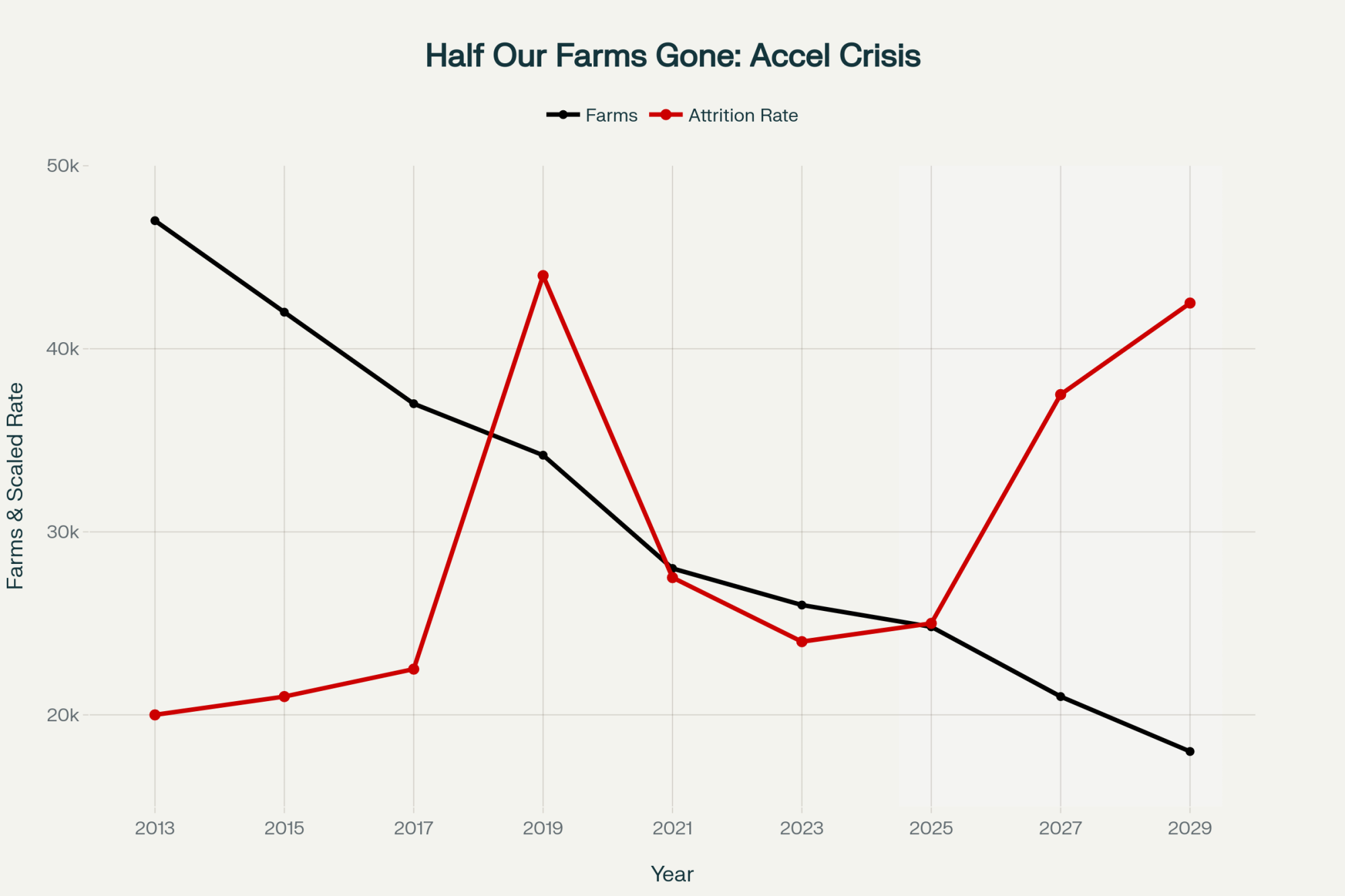
We’re not just losing farms at the historic 4% rate—we’re accelerating toward 7-9% annual losses. If you’re hanging on hoping it gets better, understand this: the industry is consolidating faster than ever, and your window to exit strategically is closing.

Mark Stephenson over at UW-Madison’s Center for Dairy Profitability, he’s been tracking these trends for years. What he and his team have documented is eye-opening. The cost gap between a 500-cow operation and one milking 3,500? It’s massive—we’re talking hundreds of thousands of dollars annually in structural disadvantage. You can optimize feed efficiency, maybe save 5%. But when the big operations are running three to four dollars per hundredweight lower in total costs? That’s not a gap you close with better management.
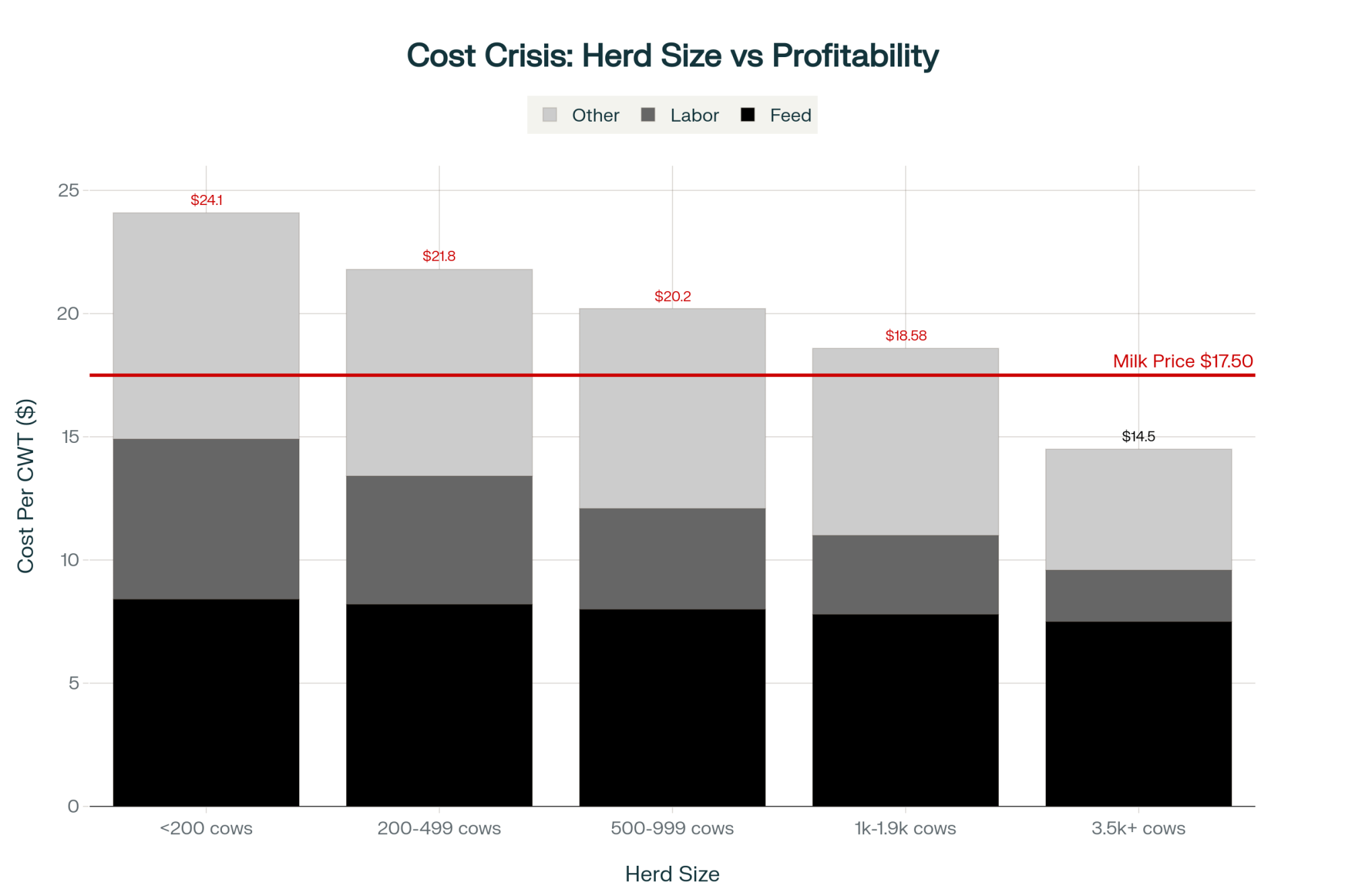
The cost gap that’s destroying family farms: small operations lose $6.60/cwt while large dairies profit $3/cwt. At 650 cows producing 80 lbs/day, that’s $34,320 monthly—enough to burn through your equity in 25 months.

“I dropped $180,000 on robotic milkers last year. Thought I was crazy at the time. But with agricultural labor costs running north of twenty bucks an hour—if you can even find people—that investment’s already cash-flowing positive.” — Dairy farmer, Eau Claire area, 1,100 cows

And here’s the thing he pointed out: feed costs are only about 35-40% of his total expenses now. It’s everything else that’s killing margins.

The Information Game During Shutdowns (And Why We’re Losing It)

What this shutdown has really exposed is something we haven’t wanted to acknowledge about modern dairy economics. While government data collection sits frozen, the processors? They’re operating with full market intelligence through their private channels.

Take a look at what’s been happening in Chicago trading. Butter’s been bouncing around $1.60 per pound. Cheese blocks are pushing toward $1.80. The spread between Class III and Class IV pricing? It’s wider than we’ve seen in years, based on CME data.

Now, if you’re a processor with trading desk access and those expensive market analytics subscriptions—you know exactly what’s happening in real-time. But farmers without the weekly USDA Dairy Market News reports we usually rely on? We’re negotiating in the dark.

And it gets worse. The Federal Milk Marketing Order formulas—you probably know this already—they’re still using butterfat standards from 2000. Three and a half percent. But today’s milk? Based on USDA testing data, most of us are running 3.9 to 4.1 percent butterfat, especially with the genetics we’ve selected for. That gap between what we produce and what the formulas recognize? It’s real money left on the table. Every load.

Marin Bozic, assistant professor of dairy economics at the University of Minnesota, has been analyzing these formula issues. “The disconnect between current milk composition and FMMO standards represents a significant value transfer from producers to processors,” he noted in recent extension materials. “We’re talking millions annually across the industry.”

Three Paths That Actually Work (And One Nobody Talks About)

After comparing notes with producers from California to Vermont, here’s what I’ve found: there are basically three business models that can work in today’s dairy. Everything else is just… different speeds of losing money.

Path 1: Going Big—Really Big

I know a producer in Idaho who made this jump two years back. Went from 800 cows to 3,600. “The math is brutal but simple,” he told me. At 800 cows, he was bleeding money—losing close to two hundred grand a year. At 3,600? He’s profitable. Same milk price, totally different economics.

But—and this is important—it took over four million in expansion capital. Complete management restructure. And what he calls “two years of hell” getting it all to work. Industry lenders I’ve spoken with suggest relatively few current operations could access that kind of financing. Very few.

What’s encouraging, though, is that those who do make this transition successfully often find unexpected benefits. Better animal welfare through modern facilities. Ability to attract skilled management talent. Even environmental improvements through precision nutrient management at scale.

Path 2: Premium Markets (If You’re in the Right Spot)

There’s an organic producer I know in Vermont, transitioned about four years ago. She’s refreshingly honest about it: “First three years, we lost money. Years four through six, broke even. Year seven—this year—we’re finally profitable.”

She’s getting close to forty dollars per hundredweight through her organic co-op, compared to the seventeen or so conventional farmers are seeing based on current Class III pricing. But here’s the catch—she’s 40 minutes from Burlington. Close to those premium consumers.

Research from Cornell’s dairy program shows something interesting: organic transition success rates tend to drop the further you get from metro markets. The market access piece is crucial. SARE grant applications for transition support typically close in March, so timing matters if you’re considering this path.

One success story worth noting: A group of five farms in Ohio pooled resources to create a shared organic processing facility. By working together, they reduced individual transition costs by about 40% and secured contracts before making the leap. That kind of innovation is what gives me hope.

Path 3: The Strategic Exit Nobody Wants to Discuss

And then there’s the third path. The one we don’t talk about at co-op meetings.

“I had about $850,000 in equity. Could’ve kept fighting, probably lasted three more years. Maybe walked away with a hundred grand if I was lucky. Instead? I sold strategically. Walked away with over seven hundred thousand.” — Recently retired dairyman, Marathon County, Wisconsin

He’s consulting now, helping younger farmers with business planning. His daughter started an agritourism venture. And you know what? He doesn’t regret it. “People think I gave up. I didn’t give up—I looked at the math and protected my family’s future.”

Agricultural financial advisors I’ve talked with suggest strategic exits generally preserve most of your equity—85-90% isn’t uncommon. Forced liquidations after years of losses? They tell me you’re lucky to see 20-30% recovery.

Your Three Options

Path 1 – Scale Up: Requires $3-5 million capital, 3,500+ cows, complete management restructure. Success rate high IF you can access financing (less than 5% of farms can). But those who succeed often thrive with modern efficiency.

Path 2 – Premium Markets: Organic/specialty transition needs 3-7 years losses before profitability, proximity to metro markets critical, $600K-1M transition capital required. SARE grants available (apply by March 2026).

Path 3 – Strategic Exit: Preserves 85-90% of equity NOW versus 20-30% in forced liquidation later. Allows family financial security and new opportunities. Not failure—strategic business decision.

Timeline: Next 90 days critical for decision-making while equity remains.

The Next 90 Days Matter More Than You Think

Let me share something a Fond du Lac County dairyman told me—runs about 650 cows, right in that tough middle ground:

“Every month I keep going, I’m burning through twenty-some thousand in equity. That’s college funds. That’s retirement. That’s the down payment on whatever comes next.”

That “twenty-some thousand in equity” burn isn’t just a number—it’s the cost of indecision. In 90 days, that’s over $60,000 gone. That $60,000? It’s the difference between a strategic exit where you keep most of your wealth and a forced liquidation where you’re lucky to walk away with anything. That’s your window.

The brutal math of delay: Each month burns $15K-$20K in equity while you decide. By January, indecision costs your family $60,000 in lost wealth—money you’ll never recover.

His monthly cash needs? About eighteen grand just for essentials—feed, supplies, utilities. The frozen government payments are creating a gap he can’t bridge much longer.

Wisconsin’s Farm Center, which provides financial counseling to farmers, my conversations with their staff suggest they’re getting 40-50 calls daily now. Before the shutdown? Maybe 10-15. One of their senior counselors told me something that really hit home: “We’re watching 30 years of equity disappear in 18 months. The farmers who recognize it early and make strategic decisions—they keep most of their wealth. The ones who wait? They lose everything.”

The Conversation We Need to Have

Can we talk honestly about what this stress is doing to farm families?

Multiple studies in agricultural psychology journals show farmers face significantly elevated stress and mental health challenges compared to other professions. Financial pressure is consistently identified as the primary trigger. According to conversations with Farm Aid staff, their hotline has seen a notable increase in calls this year.

Several farmers shared with me—they asked to remain anonymous—about the mental toll. One said: “I wake up at 3 AM doing the same math. How many months until we’re broke. My wife pretends she’s asleep, but I know she’s running the same numbers.”

The narrative that equates strategic exit with failure? It’s literally destroying people. As agricultural mental health professionals have been saying, recognizing an unwinnable situation and protecting your family isn’t giving up—it’s wisdom.

Resources That Can Actually Help

For those evaluating options, here are organizations that farmers have found helpful:

Financial Planning:

  • Farm Financial Standards Council offers free cash flow analysis tools
  • UW-Madison’s Center for Dairy Profitability provides quarterly benchmarks
  • Agricultural financial advisors can help with exit strategy planning

Transition Support:

  • SARE offers grants up to $15,000 for transition planning (March deadline)
  • Organic Valley has specific regional openings for new members
  • Farm Credit Services offers 18-month interest-only transition financing

Mental Health:

  • Farm Aid Hotline: 800-FARM-AID
  • 988 Suicide & Crisis Lifeline
  • Rural Minds offers online support specifically for agricultural communities

The Bottom Line

After weeks of analyzing this situation and talking with farmers from every angle, something’s clear: the question isn’t whether you can survive another year. It’s whether that fight serves your actual goals.
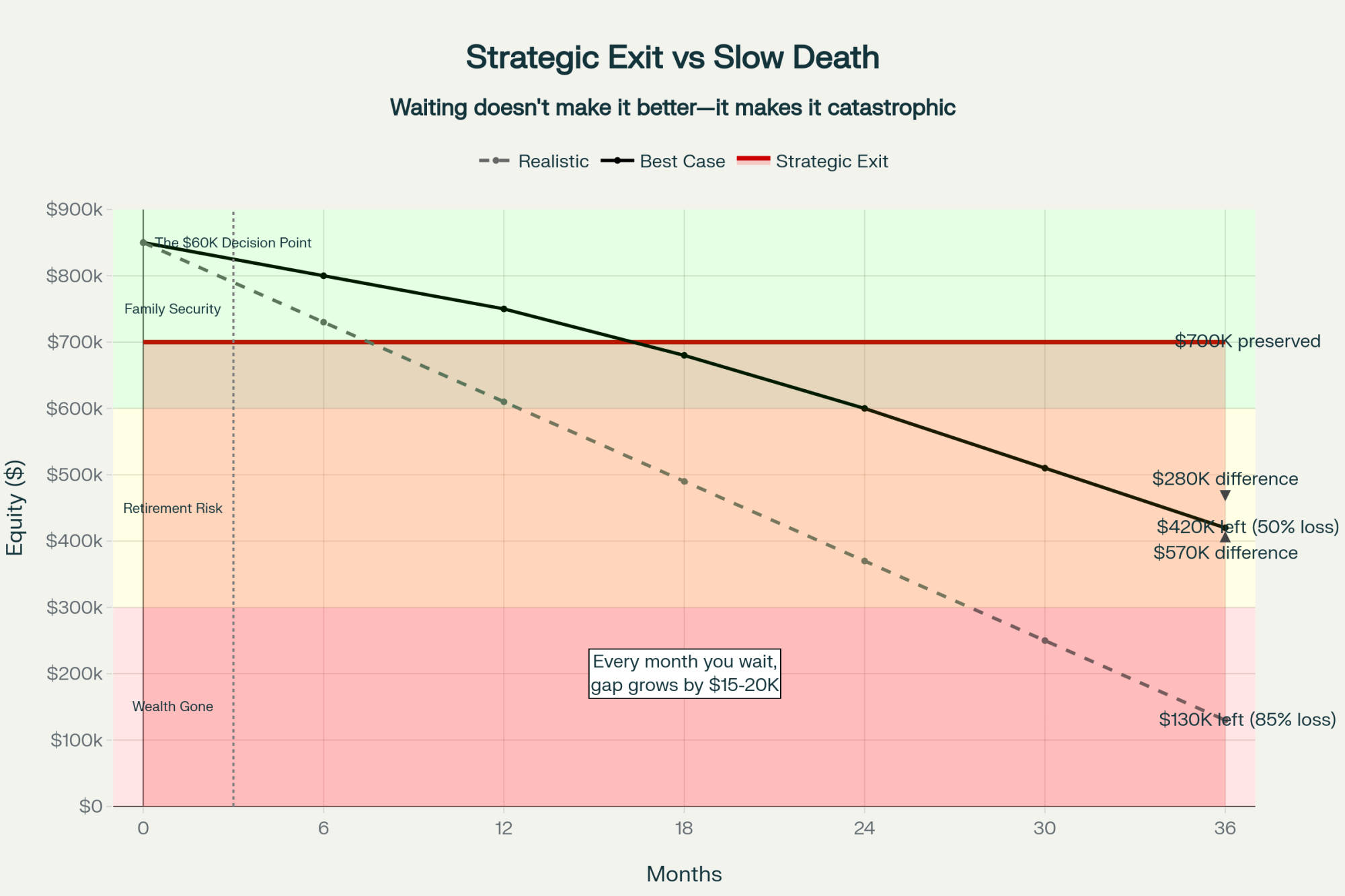
The brutal reality: exit today with $700K or wait three years and leave with $130K-$420K. That’s not a range—that’s the difference between securing your family’s future and losing everything your family built.

A fourth-generation producer from Dodge County who sold recently framed it well: “My grandfather would understand I’m protecting what he really valued—the family’s security. He adapted to his era’s challenges. I’m adapting to mine.”

You know what I find encouraging? Farmers who make peace with transition often discover unexpected opportunities. Consulting for younger farmers. Mentoring organic transitions. Exploring agrivoltaics. One former dairyman is now helping beginning farmers with direct marketing—found his passion in a completely different aspect of agriculture.

The dairy industry will survive this transformation, but it’s probably going to look quite different. Maybe 8,000-12,000 large operations. Perhaps a couple thousand premium niche producers. That seems to be where trends are pointing.

Your job—whether you’re milking 50 cows or 5,000—is to honestly assess where you fit in that future. Make decisions based on your family’s actual needs, not what you think a “real farmer” should do. Because at the end of the day, your kids need a parent more than they need a farm. Your spouse needs a partner, not a martyr.

The next 90 days… that’s your window, from what I’m seeing. Make decisions based on math and family priorities, not mythology and peer pressure. That’s the wisdom this moment demands.

And if you need to talk to someone—really talk—don’t wait. Pick up the phone. Call Farm Aid. Call a counselor. Call a friend. Because whatever path you choose, you don’t have to walk it alone.

Key Takeaways:

  • The $60,000 question: You’re burning $20K in equity monthly—by February, that’s $60K gone forever
  • Path 1 – Go Big: Scale to 3,500+ cows. Requires $4M capital. Only works if you’re in the 5% who can get financing
  • Path 2 – Go Premium: Organic/specialty markets. Expect 3-7 years of losses. Must be within 50 miles of metro markets
  • Path 3 – Get Out Smart: Exit now keeping $700K vs. waiting 3 years and walking away with $100K
  • Hard truth: No decision IS a decision—it defaults to Path 3, just costs you $600K more

Complete references and supporting documentation are available upon request by contacting the editorial team at editor@thebullvine.com.

Learn More:

Join the Revolution!

Join over 30,000 successful dairy professionals who rely on Bullvine Weekly for their competitive edge. Delivered directly to your inbox each week, our exclusive industry insights help you make smarter decisions while saving precious hours every week. Never miss critical updates on milk production trends, breakthrough technologies, and profit-boosting strategies that top producers are already implementing. Subscribe now to transform your dairy operation’s efficiency and profitability—your future success is just one click away.

NewsSubscribe
First
Last
Consent

$1.67 Cheese, 3.9 Million Heifers, $10 Billion in Steel: The Math That’s Rewriting Dairy’s Future

When plants need 8M lbs daily but heifers hit 47-year lows, something fundamental shifts

EXECUTIVE SUMMARY: What farmers are discovering across the dairy belt is that we’re not facing another typical downturn—we’re watching structural forces reshape the entire industry landscape. With block cheese at $1.67 per pound and heifer inventories at their lowest since 1978 (just 3.914 million head according to USDA’s January report), the traditional 18-24 month recovery cycle appears fundamentally broken. Over $10 billion in new processing capacity needs to be fed, regardless of demand, while consumer confidence sits at 55 points—its lowest level since 2020—and restaurant traffic has declined for seven consecutive months. University of Wisconsin research shows that even at $25 milk, meaningful herd expansion would take a minimum of three years, eliminating the supply response that has balanced our markets for generations. For operations facing this reality, the next 30 days represent a critical decision window: implement aggressive risk management (locking in 60-70% at current levels), optimize component revenues (potentially adding $33,000 annually for a 100-cow operation), or consider strategic transition while equity remains intact.

dairy structural shift

When block cheese crashes to $1.67 while new plants demand 8 million pounds of milk daily, something fundamental has shifted in dairy economics.

You know the rhythm. Milk prices crash, you cut costs, cull some cows, and wait 18-24 months for recovery. It’s worked since your grandfather’s time.

Yet conversations with producers across the dairy belt lately keep returning to the same concern—the playbook we’ve relied on for decades might not work this time. And honestly? They might be onto something.

Reading the Room: What Consumer Behavior Really Tells Us

The University of Michigan’s Consumer Sentiment Index reached 55 points in October, marking its third consecutive month of decline. Now, we’ve weathered confidence dips before, but here’s what caught my attention in the underlying data.

Less than half of Americans expect income growth next year, according to the Conference Board’s October release. That’s down from nearly 60% back in April. Almost half think unemployment’s heading higher. Historical patterns of the Federal Reserve suggest that when pessimism reaches these levels, actual job losses typically follow within six months.

OCTOBER 2025 MARKET SNAPSHOT

Consumer Indicators:

  • Consumer confidence: 55 points (lowest since 2020)
  • Restaurant traffic: Down seven consecutive months
  • Private label dairy: Dominates 11 of 14 categories

Supply Constraints:

  • Heifer inventory: 3.914 million (47-year low)
  • Beef-cross calves: $800-1,000 vs Holstein bulls $50-150

Industry Investment:

  • New processing capacity: $10+ billion coming online
  • Fixed costs requiring: 95%+ utilization regardless of demand

What farmers are finding—and I’m hearing this from Wisconsin to California—is that weak consumer sentiment hits dairy demand in unexpected ways. The NPD Group’s latest data show that restaurant traffic has been down for seven consecutive months through August. But here’s the kicker… Black Box Intelligence reports that fine dining experienced a 13% decline, while quick-service restaurants dropped by 3.4%.

Why should you care? Well, the International Dairy Deli Bakery Association documented that full-service restaurants use about 2-3 times more cheese per customer than QSR joints. So when Applebee’s loses traffic but McDonald’s holds steady with $5 meal deals, we’re actually losing way more cheese volume than the headlines suggest.

And get this—Technomic’s September analysis shows that even with aggressive discounting, traffic continues to decline. That’s not folks being cheap. That’s behavioral change.

The Store Brand Revolution Hiding in Plain Sight

IRI’s FreshLook data from February revealed something I don’t think we’ve fully grasped yet. Private label dairy experienced a 3.9% increase in dollar sales last year, while national brands grew by just 1%.

The Private Label Manufacturers Association now reports store brands outsell national brands in 11 of 14 dairy categories. Eleven out of fourteen!

According to the Food Marketing Institute’s September survey, 63% of consumers believe that store brands match or exceed the quality of national brands. They’re not “making do” with cheaper options anymore—they’re choosing them.

I spoke with a procurement manager from a major Midwest chain last month (I won’t name them, but you’d likely recognize the logo). Once their customers try store brand dairy at 20-30% savings, he said, maybe one in ten switches back. Maybe.

For farms shipping to processors heavily weighted toward national brands, this trend… well, let’s just say it deserves more attention than it’s getting.

That $10 Billion Processing Bet Nobody’s Talking About

CoBank documented over $10 billion in new processing capacity between 2021 and 2025. Hilmar announced their $1.1 billion Dodge City facility in May 2021. Leprino unveiled plans for their $870 million Lubbock plant that October. Valley Queen’s expanding in South Dakota.

When these decisions were made—mostly 2021 through early 2023—everything looked bulletproof. USDA’s Foreign Agricultural Service was showing 7% annual export growth. Nielsen panels indicated Americans couldn’t get enough protein. Kansas and Texas dairies were expanding at a rate of 3-4% yearly, according to NASS.

The International Dairy Foods Association told their March 2024 conference that farmers would respond to market signals. More heifers, better genetics, increased production. Made sense at the time.

Then the USDA’s January 2025 Cattle Report landed like a brick. Heifer inventories at 3.914 million head—lowest since 1978. University of Minnesota’s applied economics team ran the numbers… even with aggressive retention starting today, we’re looking at 2028 before meaningful expansion is possible.

Think about what this means. Leprino’s Lubbock plant requires approximately 3.65 billion pounds of milk annually, based on its 8-million-pound daily capacity. Standard financing on $870 million translates to approximately $60 million in annual interest. Before making a pound of cheese.

These plants can’t not run. They must operate near capacity, regardless of market conditions.

A Texas producer told me plants were competing hard six months ago—50-cent premiums weren’t unusual. Now? Those premiums are evaporating as plants lock in supply. Classic pattern, but the scale this time is unprecedented.

Why 2009’s Recovery Script Won’t Work

Looking back at 2009 helps explain why this time feels different.

Traditional 18-24 month recovery cycles are dead—2025’s flat trajectory means waiting for recovery guarantees bankruptcy

CME data shows Class III hit $8.40 in January 2009, then recovered to $16.50 by December. The FAO Dairy Price Index jumped 82% from its February bottom. Quick, painful, but quick.

What drove that recovery? The USDA’s Economic Research Service documented aggressive culling—reducing 150,000 head in six months. The government purchased 200 million pounds of powder through the Dairy Product Price Support Program. China’s imports surged 94% year-over-year, according to their customs data.

Now look at today. With heifers at 3.914 million head (according to the USDA’s January report), we can’t expand when prices recover. Beef-on-dairy economics make it worse—Agricultural Marketing Service reports from October show crossbred calves bringing $800-1,000 while Holstein bulls fetch $50-150.

University of Kentucky’s animal science department figures that’s worth $3-4/cwt if you’re breeding 30% of your herd to beef. Good money today, but it locks in lower milk production tomorrow.

Wisconsin-Madison’s dairy economics team presented data last month showing that even at a $25 milk price, a meaningful expansion takes a minimum of three years. The supply response mechanism that’s balanced our markets for half a century? It’s broken.

Government intervention? Not happening at scale. WTO rules are tighter. There is no political appetite for large dairy purchases. And China? Their Q3 2025 imports hit 15-year lows according to customs data. No cavalry coming from that direction.

Structural Shift or Normal Cycle? Here’s How to Tell

Ohio State’s ag economics team published some useful indicators in August. You’re looking at structural change when:

Feed drops, but margins don’t improve. USDA’s October Agricultural Prices report shows feed at $9.38/cwt, down from over $12. Yet, Progressive Dairy’s September cost survey found that 68% of farms reported tighter margins than ever.

Why? The Bureau of Labor Statistics reports that dairy labor has increased by 20% since 2020. Equipment costs rose 23%, according to the Association of Equipment Manufacturers. Cooperative deductions range from $2 to $3/cwt, based on the financial statements I’ve reviewed. Hidden costs are eating every penny saved on feed.

Recoveries get progressively weaker. CME historical data show that the period from 2007 to 2009 achieved a 175% price recovery. Recent cycles? Maybe 20-30% bounces. Each rebound becomes shallower because oversupply cannot be cleared with traditional mechanisms in place.

Your neighbors accelerate exits. Census of Agriculture typically shows 3-4% annual attrition. When you see multiple farms in your area close within months? That’s systemic pressure, not individual failure.

Three Paths Forward (Pick One Soon)

StrategyImplementationAnnual Impact (500-cow)TimelineSuccess Rate
Risk ManagementLock 60-70% production at $17-18/cwtSave $200,000 (limit losses to $3/cwt vs $5/cwt)Immediate (30 days)85% survive 24+ months
Component OptimizationGenomic testing + 30% beef cross + butterfat focusAdd $165,000 ($100K beef + $65K components)60-90 days full implementation70% achieve targets
Strategic TransitionExit with equity intact while values remainPreserve $2-3M equity vs 18-month bleed90-120 days for optimal exit95% preserve 60%+ equity

What’s encouraging is seeing how different operations are adapting successfully. They’re not necessarily the biggest or most efficient—they’re the ones who recognized this isn’t a normal cycle.

Risk Management That Actually Works

Traditional wisdom says hedge 40-60% to preserve upside. However, CME futures curves as of October 16 suggest that we’re facing a high probability of extended sub-$15 milk, with limited rally potential.

StoneX and other commodity advisors increasingly recommend 60-70% coverage at $17-18 through DRP or LGM-Dairy. Sounds conservative until you run the math.

For a 500-cow dairy, the difference between $5/cwt losses fully exposed versus $3/cwt with protection? That’s roughly $200,000 annually. One scenario means tough decisions. The other means bankruptcy.

Component and Diversification Strategies

Smart money controls what it can control. Genomic testing through Zoetis or similar identifies your best component producers. Breed the bottom 30% to beef. Optimize rations for butterfat and protein.

Based on current markets, a 100-cow operation might see:

  • Beef-cross premiums: $20,000 annually (October auction reports)
  • 0.2% butterfat improvement: $13,000 annually (USDA component pricing)
  • Combined: $33,000 additional revenue

That’s the difference between meeting payroll comfortably or scrambling every month.

Marketing Flexibility (Your Insurance Policy)

Remember Grassland Dairy’s April 2018 termination of 75 Wisconsin farms? Thirty days’ notice, done. That pattern accelerates during structural shifts.

Having documented alternatives—even if you never switch—changes everything. Several producers I know negotiated recent “temporary assessments” down significantly just by having options.

The 2028 Landscape

Wisconsin’s Center for Dairy Profitability projects that farm numbers will drop to 17,000-19,000 from today’s 25,000. The top 5% producing over half of the total milk supply. Median herd size is expected to reach 800-1,000 cows, compared to the current 250.

Yet total production stays flat or grows slightly. Survivors expand through acquisition—Farm Credit Services data suggests that discounts of 30-50% to replacement cost are common in many deals.

Cornell’s Dairy Farm Business Summary, combined with premium market data, identifies four survivor categories:

  • Large operations with 18% scale advantages
  • Premium producers capturing 30-60% price premiums
  • Component optimizers generating $3-5/cwt advantages
  • Strong balance sheets weathering losses through equity

California and Idaho show the preview. Wisconsin specialty cheese producers might find niches. Mid-size commodity operations in traditional dairy states? That’s the tough spot.

Your 30-Day Decision Framework

Financial advisors from Vita Plus and similar firms emphasize the importance of immediate assessment. Calculate your true breakeven—the price that, sustained 18 months, forces exit. For most, it’s $13-15/cwt.

Then, honestly assess the probability of extended pricing below that threshold. With consumer confidence at 55 points, restaurant traffic down seven months, $10 billion in new capacity, and China imports at 15-year lows… I’d say 50-60% probability. Maybe higher.

If your survival timeline looks shorter than the probable downturn duration, you’ve got three choices:

Managed adaptation: Lock in risk management, optimize components, and develop alternatives. Buys 18-24 months based on what I’m seeing.

Strategic transition: Exit with equity intact rather than bleeding out slowly. Several producers near retirement have chosen this path after running the numbers.

Expansion commitment: Well-capitalized operations near efficient scale might find acquisition opportunities. Some Wisconsin groups are already positioning for 2026 distressed sales.

The Hard Truth Nobody Wants to Say

The dairy industry will emerge stronger and more efficient, with fewer but larger operations producing the same amount of milk. That’s economic reality.

But that macro view doesn’t help individual farms facing immediate decisions. As one producer put it recently: “Three generations built this, but forcing a fourth generation into an unsustainable structure? That’s not preserving a legacy—it’s prolonging an inevitable outcome.”

A veteran dairyman shared something that stuck with me: “Being right about eventual recovery means nothing if you don’t survive to see it.”

Tomorrow’s milking happens regardless. Whether it’s part of strategic progress or gradual decline depends on the decisions made now, while options are still available.

What strikes me most is how fast things can change. Processors announce consolidations overnight. Equity built over decades evaporates in 18 months of $14 milk. Today’s heifer decisions affect 2028’s production capacity.

This isn’t pessimism—it’s pattern recognition. The forces reshaping dairy won’t adjust to individual situations. Consumer behavior, as documented by Michigan and the Conference Board, processing overcapacity confirmed by CoBank, and biological constraints verified by the USDA… these aren’t going away.

However, these same forces also create opportunities for those who anticipate them. Farms bought during the 2015 downturn at 40% discounts now generate returns that were previously impossible.

Whether your opportunity involves adaptation, consolidation, or transition depends on honest assessment and timely action. The traditional playbook won’t work here. But understanding why—and adjusting accordingly—that’s the difference between thriving through transformation and becoming another statistic.

Make your choice with eyes wide open. Whatever you decide, make it with an understanding of the forces at play and the time you have left to act.

KEY TAKEAWAYS:

  • Risk management math has changed: Locking in 60-70% of production at $17-18/cwt isn’t conservative—it’s survival insurance. For a 500-cow dairy, the difference between $5/cwt losses fully exposed versus $3/cwt protected equals roughly $200,000 annually, often determining whether you meet obligations or face insolvency.
  • Component optimization delivers immediate returns: Genomic testing to identify top performers, breeding bottom 30% to beef, and optimizing rations can generate $33,000 additional revenue for a 100-cow operation—that’s $20,000 from beef-cross premiums plus $13,000 from 0.2% butterfat improvement based on October auction reports and current component pricing.
  • Your true breakeven determines everything: Calculate the milk price that, sustained for 18 months, forces exit (typically $13-15/cwt for most operations). With current indicators suggesting a 50-60% probability of extended pricing below that threshold, survival timelines shorter than probable downturn duration require immediate strategic action.
  • Four survivor profiles are expected to emerge by 2028: large operations with 18% scale advantages, premium producers capturing 30-60% price premiums, component optimizers generating $3-5/cwt advantages, and strong balance sheet operations weathering losses through equity. Mid—size commodity producers without differentiation face the toughest transition.
  • Processing overcapacity creates permanent pressure: With facilities like Leprino’s Lubbock plant facing $60 million annual interest on $870 million investment, these operations must run at 95%+ capacity regardless of market conditions, fundamentally altering traditional supply-demand dynamics through 2027 and beyond.

Complete references and supporting documentation are available upon request by contacting the editorial team at editor@thebullvine.com.

Learn More:

Join the Revolution!

Join over 30,000 successful dairy professionals who rely on Bullvine Weekly for their competitive edge. Delivered directly to your inbox each week, our exclusive industry insights help you make smarter decisions while saving precious hours every week. Never miss critical updates on milk production trends, breakthrough technologies, and profit-boosting strategies that top producers are already implementing. Subscribe now to transform your dairy operation’s efficiency and profitability—your future success is just one click away.
NewsSubscribe
First
Last
Consent

Will Your Dairy Farm Survive the Next Decade? The Brutal Math of Consolidation

50% of U.S. dairies have vanished since 2013. Will yours survive the next bloodbath? The math doesn’t care about tradition – adapt or die.

EXECUTIVE SUMMARY: The U.S. dairy industry’s consolidation is accelerating, with half of all farms disappearing since 2013 and another 50% projected to vanish by 2035. Survival hinges on scaling to 1,000+ cows or pivoting to niche markets like organic/grass-fed production while leveraging cost-slashing techs like robotics and genomics. Mega-dairies now dominate 70% of milk output, leaving smaller farms battling volatile prices and 34% higher feed costs. Brutal economics favor radical growth or hyper-specialization, with collaboration and tech adoption becoming non-negotiable. The clock is ticking farms must choose their path now or join the 4% annual closure rate.

KEY TAKEAWAYS:

  • Consolidation is accelerating: Industry half-life shrunk from 12 to 10 years – 12,000 farms will remain by 2035.
  • Scale = survival: 1,000+ cow herds operate at 18% lower costs; sub-500 cow farms need niche strategies (organic, grass-fed, tech-micro dairies).
  • Tech is the great equalizer: Robotics, genomics, and methane digesters separate winners from casualties.
  • Collaborate or perish: Resource-sharing cooperatives and collective bargaining offset consolidation pressures.
  • No middle ground: Operators must commit to growth or specialization – hesitation guarantees obsolescence.

The numbers don’t lie: 50% of U.S. dairy farms vanished between 2013 and 2025. If that gut-punch statistic doesn’t rattle you, consider this—the industry’s consolidation “half-life” is accelerating. What took 12 years to cull half our farms now happens in 10. By 2035, only 12,000 dairies will remain. The question isn’t whether consolidation will claim more farms but whose. Are you evolving fast enough to outpace the 4% annual closure rate, crushing your neighbors? Let’s pull no punches: survival demands radical adaptation.

The Great Dairy Shakeout: By the Numbers

Here’s the cold reality:

  • Milk production surged 25.3 billion pounds since 2013, but 48 states lost dairy farms.
  • Texas added 195,000 cows while traditional strongholds like California bled operations.
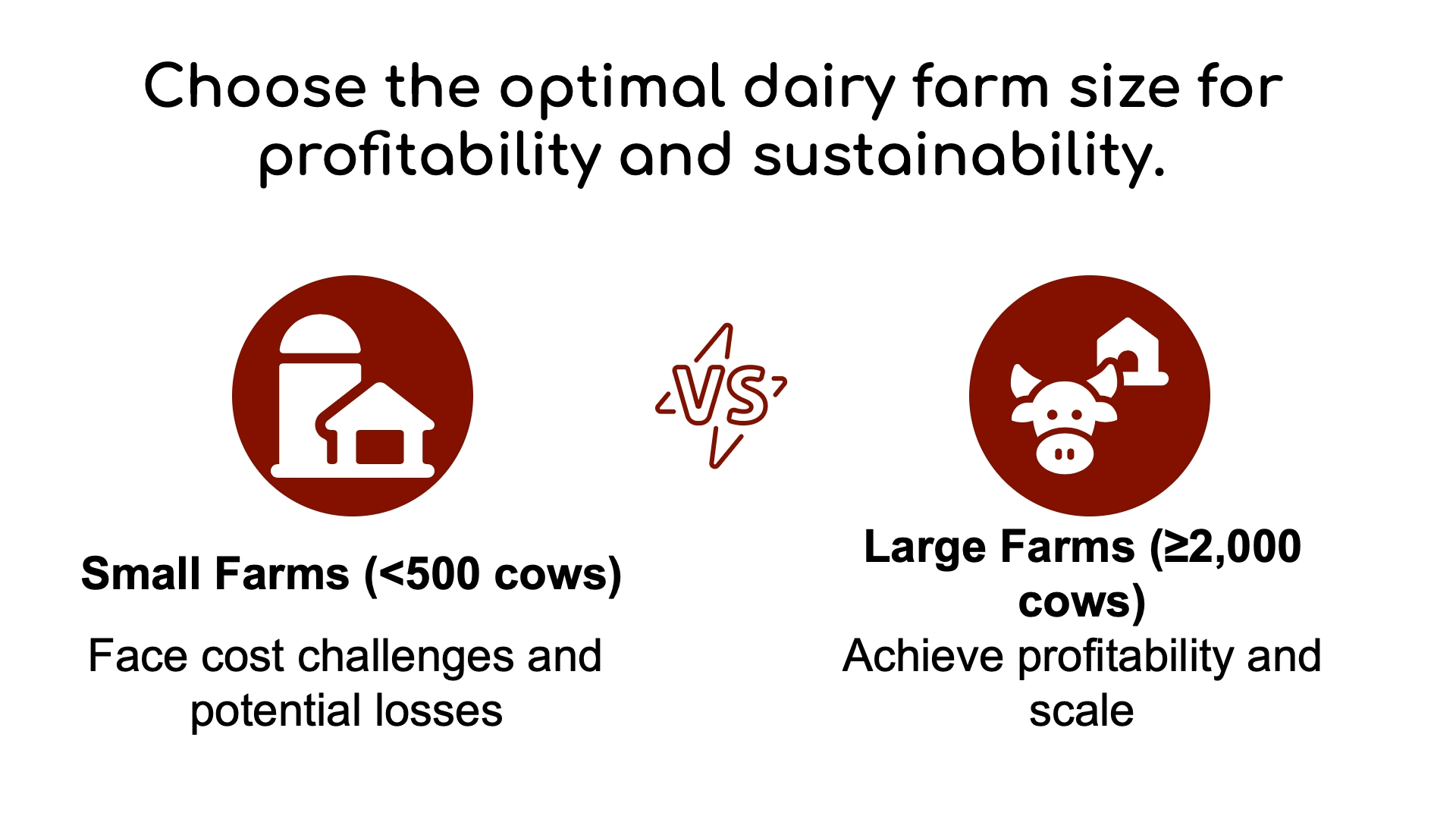
  • 80% of farms milk <500 cows, yet 70% of U.S. milk flows from 1,000+ herd mega-dairies.

This isn’t your grandfather’s industry. The USDA confirms what every farmer feels: scale equals survival. Herds under 500 cows face average costs exceeding milk prices, while 2,000+ cow operations turn profits. Dennis Rodenbaugh, CEO of Dairy Farmers of America (DFA), says, “Anticipating disruption isn’t optional. You build bridges to the future or get washed away”.

Scale or Fail: The New Reality of Milk Production

Forget ‘if’—ask ‘how fast’ you’ll scale. The 1,000-cow threshold isn’t arbitrary. USDA data shows these herds achieve 18% lower production costs than 500-cow operations through bulk purchasing, robotic efficiencies, and negotiating power.

But growth ain’t for the faint-hearted. Rodenbaugh warns, “Get disciplined or get out. The storm separating winners from casualties is accelerating”. Case in point: Midwest families selling out to Panhandle conglomerates where 25,000 cow goliaths churn out milk cheaper than Wisconsin’s pastures ever could.

The Price of Standing Still:

  • Feed costs up 34% since 2020
  • Heifer replacement expenses doubling
  • Milk price volatility swinging ±25% annually

“You’re either acquiring neighbors or becoming acquired,” says a fourth-gen Wisconsin dairyman who tripled his herd to 900 cows. “My kids won’t survive on 300-head nostalgia.”

Beyond Expansion: Alternative Paths Through the Storm

Not everyone can—or should—chase mega-dairy status. For sub-500 herds, niching down beats scaling up:

1. Organic Premium Play

  • Organic milk fetches $32.69/cwt vs. $21.50 conventional
  • But tread carefully: transitioning requires 3 years and $150K+ certification costs

2. Grass-Fed Guerrilla Tactics

  • Direct-to-consumer raw milk sales bypass processors, capturing a 300% markup
  • Caveat: Regulatory landmines lurk in 38 states

3. Tech-Enabled Micro-Dairies

  • Robotic milkers slashed labor by 40% for a 150-cow Vermont operation
  • AI breeding algorithms boosted conception rates by 22%

Sarah Lloyd, a Wisconsin dairy advocate, argues: “We’ve romanticized ‘get big or get out.’ Smart-small dairies leveraging tech and margins can outmaneuver dinosaurs”.

The Innovators: Tech Titans Reshaping Dairy

Game-changing tools separating survivors from the bankrupt:

TechnologyCost RangeROI TimelineHerd Size Suitability
Automated Feed Systems$50K–$200K2–4 years500+ cows
Methane Digesters$1M–$5M5–7 years1,000+ cows
Genomics Testing$25/headImmediateAll sizes
Robotic Milkers$150K–$250K/unit3–5 years100–500 cows

Texas’s 5,000-cow colossus slashed labor costs by 60% via drones monitoring herd health. Meanwhile, Idaho’s 120-cow boutique dairy uses blockchain to trace grass-fed butter to Manhattan chefs at $12/lb.

The Bottom Line: Blood, Sweat, and 4% Annual Decline

Dairy’s Darwinian reckoning won’t pause for sentiment. Here’s your survival checklist:

  1. Crunch your half-life math: If scaling to 1,000+ cows seems impossible, pivot to hyper-specialization now.
  2. Embrace ‘coopetition’: Pool resources with neighbors for bulk inputs, tech sharing, and collective bargaining.
  3. Bet on genomics: Top 1% genetics can boost yields 2,000+ lbs/cow annually.

Rodenbaugh’s final word? “The dairy game isn’t dying—it’s evolving. Future winners think in decades, not seasons”.

Your move. Will you be among the 12,000 left in 2035—or a statistic in The Bullvine’s following obituary for America’s heartland?

Learn more:

Join the Revolution!

Join over 30,000 successful dairy professionals who rely on Bullvine Daily for their competitive edge. Delivered directly to your inbox each week, our exclusive industry insights help you make smarter decisions while saving precious hours every week. Never miss critical updates on milk production trends, breakthrough technologies, and profit-boosting strategies that top producers are already implementing. Subscribe now to transform your dairy operation’s efficiency and profitability—your future success is just one click away.
NewsSubscribe
First
Last
Consent

Send this to a friend





